Clean Industrial Solutions and Aid Framework (CISAF)

πŸ“’ On 25 June 2025, the European Commission adopted the Clean Industrial Solutions and Aid Framework (CISAF) β€” a major step to align State aid rules with the goals of the Clean Industrial Deal.

This new framework provides targeted support for low-carbon fuels, including low-carbon hydrogen, RFNBOs, and synthetic fuels, through structured investment aid schemes.

πŸ”Ή What’s new for hydrogen and e-fuels?

The European Commission will consider compatible with the internal market aid measures to support:

  • investments for the production of low-carbon fuels
  • investments for the production of RFNBOs
  • investments in storage for low-carbon fuels that store exclusively low-carbon fuels, or a mix of low-carbon fuels and RFNBOs.

πŸ”Ή Key conditions:

  • 30% of budgets must be reserved for RFNBOs
  • GHG reduction threshold of 70% for low-carbon fuels
  • Aid applies only to new capacity
  • Schemes must remain open, non-discriminatory, and compliant with the ‘Do No Significant Harm’ principle.

βœ… This is a promising signal for project developers and industrial actors across Europe. The CISAF framework may play a critical role in de-risking early investments in the hydrogen economy and scaling up low-carbon fuel production.

➑️ Source: Clean Industrial Deal State Aid Framework (CISAF)

Regulatory Update: Low-Carbon Hydrogen Rules

In Search of the Real Price of Blue Hydrogen

Source: In Search of the Real Price of Blue Hydrogen

πŸ“’ Regulatory Update: Low-Carbon Hydrogen Rules

The European Commission plans to finalize the Delegated Act for low carbon hydrogen in the coming months, with implementation planned before the end of the year.

At the same time, growing concerns remain about the viability blue hydrogen. This is confirmed in the recent report by the Green Hydrogen Organization: β€œIn Search of the Real Price of Blue Hydrogen”, available via this link.

βœ… Key Takeaways from the report:

πŸ“Œ Low-carbon hydrogen – not proven at scale

  • No current projects meet the emissions criteria of the EU, US, UK, Japan, or Korea.
  • True low-carbon production would require 95%+ carbon capture and permanent, verifiable COβ‚‚ storage

πŸ“Œ Carbon capture performance is inconsistent

  • Among 16 reviewed CCS projects, none have consistently captured more than 80% of COβ‚‚ emissions.

πŸ“Œ High uncertainty = risky pricing assumptions

  • Unlike green hydrogen projects, carbon capture assumptions are not validated by real-world performance.
  • Volatile gas prices and gaps in life-cycle emissions reporting make pricing blue hydrogen highly speculative.

β˜‘οΈ CONCLUSION: clarity, predictability, and consistency in definitions and requirements will be essential to build trust and attract investment in low-carbon hydrogen pathways.

➑️ Source: Commission’s draft rules make low-carbon hydrogen β€˜practically impossible’, say stakeholders

Renewable Energy Directive (RED III) implementation in Germany

RED III implementation in Germany

The German Federal Ministry for the Environment has submitted a draft bill for the further development of the GHG reduction quota for consultation with associations. The law serves to implement the requirements of the amended Renewable Energy Directive (RED III).

βœ… The main changes:

πŸ“Œ General overview:

  • The mandatory percentage reduction in GHG emissions for fuels will be set until 2040 and will gradually increase to 53%.
  • The GHG reduction quota must be met by all fuel suppliers for all transport sectors.
  • The separate quota for RFNBO in aviation will be replaced by a general quota for all transport sectors.
  • The quota for advanced biofuels will be increased and the double counting will be abolished.
  • Renewable fuels can only be counted if on-site inspections by government inspectors are possible.

πŸ’§ The minimum shares of RFNBO for the transport sector is:

  • 0.1 % from 2026,
  • 0.5 % from 2028,
  • 1.5 % from 2030,
  • 2 % from 2032,
  • 3 % from 2034,
  • 5 % from 2035,
  • 7 % from 2037,
  • 9 % from 2039,
  • 12 % from 2040.

πŸ“Š For the calculation of the reference value against which the GHG reduction must be achieved, the energetic quantity of the RFNBO multiplied by a factor of:

  • 3 from the commitment year 2024,
  • 2.5 from the commitment year 2035,
  • 2 from the commitment year 2036,
  • 1.5 from the commitment year 2037,
  • 1 from the 2038 commitment year.

The factors shall additionally be multiplied by 1.5 if the respective fuel is used in aircraft or vessels.

✈️ Aviation:

  • Previous PtL Quotas for aircrafts (in paragraph 4a Β§ 37a) are excluded;
  • New PtL Quotas are defined under the ReFuelEU Aviation Regulation;
  • An aviation fuel supplier is defined as anyone who, on a commercial basis or within the framework of commercial enterprises pursuant to the Energy Tax Act, places on the market aviation turbine fuel under subheading 2710 19 21 of the Combined Nomenclature.
  • Penalties for non-compliance with PtL Quotas by aviation fuel suppliers:
    • for SAF – EUR 4,700 per tonne;
    • for e-SAF – EUR 17,000 per tonne.

➑️ Source: Referentenentwurf eines zweiten Gesetzes zur Weiterentwicklung der Treibhausgasminderungs-Quote

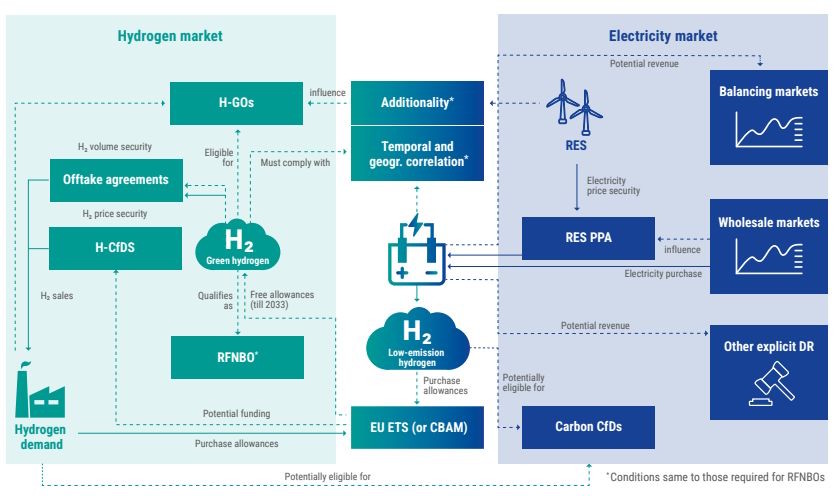
The Impact of Renewable Hydrogen on the Power System

electrolyser at the intersection of the hydrogen and electricity markets, the associated revenue streams, and possible support mechanisms

Figure: Electrolyser at the intersection of the hydrogen and electricity markets, the associated revenue streams, and possible support mechanisms

Source: Market Design and Regulatory Framework for Viable and Flexible Hydrogen Production Report, June 2025

New ENTSO-E Report: The Impact of Renewable Hydrogen on the Power System

This comprehensive report offers valuable insights into the growing hydrogen market and its interdependence with the electricity system.

βœ… Key Takeaways:

πŸ“Œ System Integration is Key

Electrolysers and hydrogen facilities should be strategically planned, located, and operated in coordination with the power system to maximise system benefits and consumer value.

πŸ“Œ Location Matters

Whether near renewable energy sources, hydrogen demand centers, or both β€” the siting and grid connection (on-grid/off-grid) of electrolysers are crucial for infrastructure optimisation, especially as natural gas is phased out.

πŸ“Œ Smart Regulation & Market Design

Policies defining renewable hydrogen must consider not just the hydrogen sector, but also incentivise investments that support the power system and accelerate decarbonisation.

πŸ“Œ Flexibility Potential

Electrolysers could provide valuable short-duration flexibility via implicit and explicit demand response, especially as the market matures.

πŸ“Œ Contributing to Resource Adequacy

Power-to-Hydrogen (P2H2) supports the grid through demand response. Hydrogen-to-Power (H2P) can offer carbon-neutral backup via repurposed gas turbines and capacity mechanisms.

πŸ“Œ Certification Trade-offs

Hydrogen regulation (e.g., GOs and RFNBO criteria) must find a balance between strict decarbonisation goals and power system needs. To strike a balance, GOs and RFNBO requirements should be designed with flexibility in mind.

➑️ Source: Report on Impact of Renewable Hydrogen on the Power System

Hydrogen in the Reformed EU ETS

green and blue hydrogen costs

Figure: Comparing green (left) and blue hydrogen (right) costs accounting for EU ETS impacts (assumed CO2 price: 80 €/tCO2) based on the optimistic end of near-term cost estimates for 2025 to 2030. The value of free allocations is calculated based on CBAM factor of 100 %, which applies until the end of 2025. No additional subsidies considered here.

Source: Nils Bruch, Falko Ueckerdt, MichΓ¨le Knodt (2025): Hydrogen in the Reformed EU ETS – Implications for Competitiveness and Emissions Reductions. Kopernikus-Projekt Ariadne, Potsdam.

Hydrogen in the Reformed EU ETS: What It Means for Competitiveness and Emissions Reductions?

πŸ”Ή Key insights:

πŸ“Œ The EU ETS alone cannot make hydrogen competitive.

  • Hydrogen production (both renewable and blue) remains significantly more expensive than natural gas β€” currently 4 to 6 times more costly.
  • The value of freely allocated ETS allowances does little to close this gap, as illustrated in the picture below with the green part, especially with today’s relatively low COβ‚‚ prices.

πŸ“Œ To bridge the cost gap and enable a fuel switch from natural gas to low-carbon or renewable hydrogen, COβ‚‚ prices of €300–500/tCOβ‚‚ would be necessary.

πŸ“Œ Switching from blue to green hydrogen would require €2500/tCOβ‚‚ if only downstream emissions are priced.

βœ… Policy recommendations include:

πŸ“Œ Expanding the EU ETS to cover upstream emissions for a more accurate climate cost signal.

πŸ“Œ Gradually lowering the emission intensity threshold (currently 28.2 gCOβ‚‚eq/MJ) for low-carbon hydrogen to encourage innovation and deeper decarbonisation.

πŸ’‘ To use hydrogen for the energy transition, it is essential to go beyond emissions pricing and rethink how to support its competitiveness and climate impact.

IEA World Energy Investment 2025 Report

investment in selected low-emissions fuels in selected regions, 2023, 2024 and 2025

Figure: Investment in selected low-emissions fuels in selected regions, 2023, 2024 and 2025

Source: World Energy Investment 2025 report, 10th Edition

Investment in liquid biofuels, biogases and hydrogen is set to rise by 30 % in 2025, to nearly $25 billion, building on a 20 % rise in 2024.

πŸ“Œ Low-emissions fuel spending varies greatly by region:

  • in 2024, Europe accounted for 60% of global investment in biogases;
  • the US made up 70% of global investment in biojet kerosene;
  • China has large investments in hydrogen;
  • Brazil focuses on liquid biofuels.

πŸ“Œ Investment in liquid biofuels, biogases and low-emissions hydrogen is set to rise by 30% in 2025 to a record high close to USD 25 billion, building on a 20% rise in 2024.

πŸ“Œ Policies and regulations remain essential to this growth: mandates, quotas and other forms of policy support have underpinned the high levels of investment in biodiesel and ethanol in the United States and Brazil and in biogases in Europe.

πŸ“Œ Some hydrogen projects have been cancelled or delayed in the past 12 months, but there remains a pipeline of projects that have received FID, requiring around USD 8 billion of investment in 2025, a 70% increase from the level in 2024.

πŸ“Œ For hydrogen:

  • there were a number of setbacks for projects around the world, nonetheless, investment rose by 60% in 2024, and there remains a large pipeline of hydrogen production projects that have received FID.
  • government support has continued in 2025 globally, for example, in Australia and the EU.
  • all hydrogen projects that have received FID would require investment almost USD 8 billion and would increase capacity to around 7.5 Mt in 2035.

➑️ Source: World Energy Investment 2025 report, 10th Edition

Regulatory work in PtX projects

regulatory frameworks across countries

Source: Sustainability regulations for PtX projects

Why does regulatory work matter in PtX projects?

Because the success of PtX projects doesn’t just depend on technology β€” it also depends on navigating a complex and often fragmented regulatory landscape.

The table above highlights how diverse and misaligned regulatory frameworks are across countries.

This complexity becomes even more critical for import-oriented PtX projects, where compliance is needed with both the exporting and importing country’s rules.

βœ… Key challenges:

πŸ“Œ Diverging national regulations

πŸ“Œ Different GHG emission thresholds

πŸ“Œ Contradictions between high renewable potential and low renewables deployment in some exporting countries.

These factors can hinder project bankability, delay timelines, or even block market access.

That’s why aligning regulatory frameworks β€” or at least understanding and navigating their discrepancies β€” is crucial for enabling global hydrogen and e-fuel markets.

➑️ Source:

Stefan Bube, Katja Lange, Dayana Granford Ruiz, Sebastian Schindler, Marie Plaisir, Martin Kaltschmitt, Jochen Bard, Klemens Ilse.
Sustainability regulations for PtX projects: Scope and impact analysis,
Joule,
Volume 9, Issue 6,
2025,
101966,
ISSN 2542-4351,
https://doi.org/10.1016/j.joule.2025.101966.

Mapping the cost competitiveness of African green hydrogen imports to Europe

Overview of African green hydrogen projects by country and end use

Figure: Overview of African green hydrogen projects by country and end use

Source: Mapping the cost competitiveness of African green hydrogen imports to Europe

πŸ“ƒ Article “Mapping the cost competitiveness of African green hydrogen imports to Europe” was published by researchers of the Technical University of Munich (TUM), the University of Oxford and ETH Zurich.

βœ… The Key Findings:

πŸ“ŒThe research covers:

  • all projects planned to be operational by 2030.
  • the analysis of African countries with port access.
  • 31 countries, except Somalia and Libya, were excluded due to political instability and small island states.

πŸ“Œ Overview of African green hydrogen projects:

  • 34 projects are found across 7 countries;
  • 89% of projects are either at concept or feasibility stages;
  • 2 of the projects have reached a financial investment decision and are under construction, and only one small-scale project (that is, 3.5 MW) in South Africa is operational;
  • From 3.5 MW to 6.9 GW is planned project sizes;
  • 74% of planned electrolyser capacity is intended for ammonia (NH3) production

πŸ“Œ Levelized cost of hydrogen (LCOH):

  • In a high interest scenarios 1 and 2, least costs for green H2 exported from Africa are €4.9 kgH2βˆ’1 without policy support and €3.8 kgH2βˆ’1 when fully de-risked by European governments.
  • In a low interest scenarios, the costs come down to €4.2 kgH2βˆ’1 and €3.2 kgH2βˆ’1, respectively.
  • no location competitive with the first round of auction results by the European Hydrogen Bank, which yielded a lowest bid of €2.8 kgH2βˆ’1 in Spain.

πŸ“Œ Challenges:

  • many low-cost locations are in regions that are either politically contested or encounter relatively regular flares of armed conflict.
  • the size of the planned investments relative to the GDP raises questions on feasibility. This situation is concerning as many African countries face massive foreign debt burdens.
  • whereas wind resources are critical to low-cost green H2 production, local expertise to install this wind capacity may be insufficient.
  • some low-cost locations, such as those near the Red Sea or the river Nile in Egypt, may also face challenges of water insecurity potentially disrupting consistent production.

➑️ Source: Egli, F., Schneider, F., Leonard, A. et al. Mapping the cost competitiveness of African green hydrogen imports to Europe. Nat Energy (2025).

ICAO dashboard update

ICAO web site

Source: ICAO web site

✈️ The International Civil Aviation Organization (ICAO) updated the dashboard with publicly-available information on sustainable aviation fuel (SAF) offtake agreements.

πŸ“Œ This dashboard covers various locations worldwide.

πŸ“Œ Volumes refer to neat SAF; in case of blended SAF announcements the volumes refer to the fraction of SAF in the blend.

➑️ Source: ICAO web site. Offtake Agreements

EU Startup and Scaleup Strategy

EU Startup and Scaleup Strategy

On 28 May 2025, the European Commission has launched the EU Startup and Scaleup Strategy, to make Europe a great place to start and grow global technology-driven companies.

βœ… The EU Startup and Scaleup Strategy aims to make Europe the best place in the world to launch and grow global technology-driven companies, including deep tech companies. This is crucial for strategic technologies, such as for example cleantech and energy (including nuclear technology).

β˜‘οΈ The key needs of startups and scaleups:

πŸ“Œ Fostering innovation-friendly environment:

  • Startups and scaleups need less fragmentation, fewer administrative burdens, as well as rules that are simpler and more supportive across the Single Market.
  • a European 28th regime will be proposed to simplify rules and reduce the cost of failure by addressing critical aspects in areas like insolvency, labour and tax law.
  • The European Business Wallet will enable seamless digital interactions with public administrations across the EU through a unified digital identity for all economic operators.
  • The forthcoming European Innovation Act will further support innovation by promoting regulatory sandboxes.

πŸ“Œ Driving better financing:

  • The Savings and Investments Union initiative will be key to unlocking more financing and investment opportunities in the EU.
  • The Strategy aims to expand and simplify the European Innovation Council, deploy a Scaleup Europe Fund to help bridge the financing gap of deep tech scale-up companies, and develop a voluntary European Innovation Investment Pact to mobilise large institutional investors to invest in EU funds, venture capital funds and unlisted scaleups.

πŸ“Œ Supporting market uptake and expansion:

  • The Strategy introduces a Lab to Unicorn initiative, which includes the European Startup and Scaleup Hubs.

πŸ“Œ Attracting and retaining top talent:

  • The Strategy introduces the Blue Carpet initiative, notably focusing on entrepreneurial education, tax-related aspects of employee stock options and cross-border employment.
  • The Blue Card Directive will be promoted to put in place a fast-track schemes for non-EU founders.

πŸ“Œ Facilitating access to infrastructure, networks and service:

  • The Strategy proposes to simplify and harmonise diverging access and contractual conditions for startups and scaleups to technology and research infrastructures through a Charter of Access for industrial users.

➑️ Source: Commission launches ambitious Strategy to make Europe a startup and scaleup powerhouse