

Climate Change Performance Index 2026
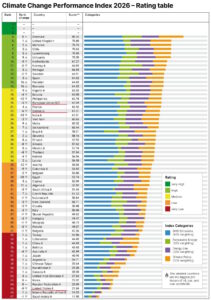
📢 The Climate Change Performance Index 2026 illustrates how the regulatory framework influences the achievement of climate targets.
The Climate Change Performance Index (CCPI) is an independent monitoring tool for the climate mitigation performance of 63 countries and the EU.
✅ Key Takeaways:
📌 No country is strong enough in all categories to achieve an overall very high rating. Therefore, the top three places continue to be vacant.
📌 Denmark remains the top-ranked country but falls short of earning an overall very high rating.
📌 Overall, the EU falls three spots, to 20th, and has a medium overall ranking.
📌 Eight EU countries are among the high performers, with Denmark (4th) and Luxembourg (8th) upfront.
📌 No EU country receives an overall very low rating. Bulgaria, at 51st, is still the worst-performing EU country, as nine other EU countries receive an overall low ranking.
📌 The European Union (EU):
- It ranks 20th in this year’s CCPI, down three spots from last year and receives medium ratings across the board in: GHG Emissions, Renewable Energy, Energy Use, and Climate Policy;
- The CCPI experts question the likelihood of member states’ full implementation of the revised National Energy and Climate Plans (NECP) regarding the 2030 target published in May 2025
- RED III provides a policy framework with an overall EU minimum binding target of 42.5%, although the experts criticise the lack of national binding targets and weak enforcement.
- Implementation remains a major gap, with the European Commission having launched infringement procedures against 26 member states for non-compliance.
📌 Germany
- Germany drops six places to 22nd in this year’s CCPI;
- Planned gas power capacity risks a fossil fuel lock-in;
- The overall ranking decline can be attributed to its announcements to weaken existing climate legislation and unnecessarily expand gas power plants.
- Hydrogen ramp-up and the development of a capacity market, for when RE does not generate sufficient power, are also moving too slowly. Offshore and onshore wind expansion remain below what is needed.
📌 The United States:
- The United States falls eight spots from 57th to 65th and remains a very low performing country.
- Key policies supporting renewable energy build-up and GHG emissions reduction have been revoked alongside promotion of fossil fuel expansion.
- Key support schemes from the Inflation Reduction Act, such as the Environmental Protection Agency’s Solar for All program and clean energy tax credits, have been rescinded or weakened.
- Some states, such as New York and California, still have policies in place to combat climate change and legislators strive to protect these from national-level policies and decrees through the U.S. Climate Alliance.
➡️ Source: Climate Change Performance Index. Ranking