German Aid for Canadian Renewable H2

European Commission approves German Aid for Canadian Renewable Hydrogen

📢 New funding opportunities for hydrogen projects in Canada.

The European Commission has approved a €200 million German State aid scheme to support the production of renewable hydrogen and its derivatives (RFNBOs) in Canada for supply to the EU market.

✅ Key elements of the German support scheme:

📌 Germany notified the Commission of a €200 million support programme, complemented by an additional €200 million in Canadian funding, to enable cost-efficient RFNBO production in Canada.

📌 The scheme aims to incentivise the construction of up to 300 MW of electrolysis capacity through a competitive bidding process, expected to conclude in 2027.

📌 It is based on a double auction model, matching RFNBO producers in Canada with buyers in the EU. Producers offering the lowest supply price and buyers offering the highest offtake price will enter into a contractual relationship with State resources helping to fill the funding gap between the two prices.

📌 Beneficiaries must demonstrate full compliance with EU RFNBO sustainability and certification criteria, as defined in the delegated acts on renewable hydrogen.

📌 The scheme is expected to avoid up to 2.47 million tonnes of CO2-equivalent emissions.
➡️ Source: Commission approves €200 million German State aid for Canadian-produced renewable hydrogen and its derivatives for EU market

Pacific Northwest Low-Carbon Hydrogen Analysis

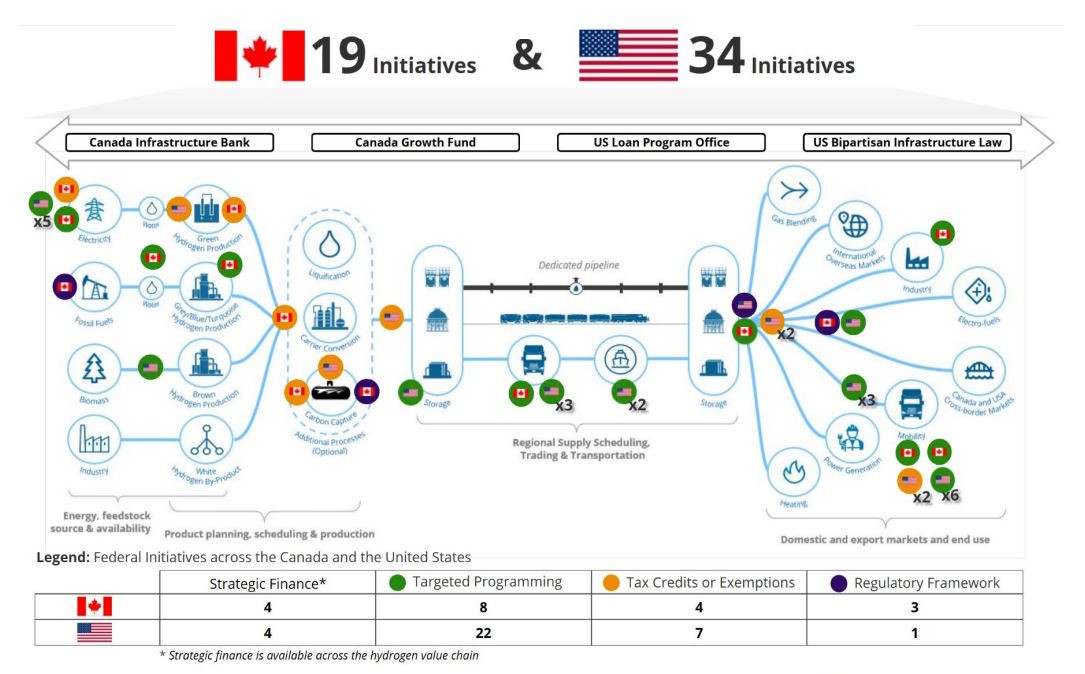
Low-Carbon Hydrogen Analysis. Federal Initiatives across the Canada and the United States. Canada and United States support initiatives and value chain applicability

Figure: Canada and United States support initiatives and value chain applicability

Source: New report: Pacific Northwest Low-Carbon Hydrogen Analysis

Pacific Northwest Low-Carbon Hydrogen Analysis, published by The Pacific Northwest Economic Region (PNWER), provides a comprehensive view of supply, demand and trade opportunities for low-carbon hydrogen between the US and Canada.

✅ Some takeaways

📌 Canada:

  • has a total of 19 direct or indirect support programs available to accelerate the development and deployment of hydrogen technologies and industry across the value chain.
  • Tax measures such as the Clean Hydrogen Investment Tax Credit (ITC), Clean Technology ITC, Clean Technology Manufacturing ITC, and the Carbon Capture, Utilization and Storage (CCUS) ITC are complemented by funding programs such as the Clean Fuels Fund and Strategic Innovation Fund – Net-Zero Accelerator.

📌 The US:

  • has a total of 34 direct or indirect federal programs and initiatives across multiple national departments and agencies, which enable the use of hydrogen across the value chain.
  • The US Renewable Fuel Standard (RFS) mandates the blending of renewable fuels into the supply of transportation fuels, with an aim at reducing overall GHG emissions from the sector. While the RFS primarily focuses on biofuels, it also includes provisions for hydrogen derived from renewable feedstocks, like biomass, which generates an economic incentive for the transportation sector to include low-carbon hydrogen in its pathways to decarbonization.

➡️ Source: New report: Pacific Northwest Low-Carbon Hydrogen Analysis