New EU funding opportunities

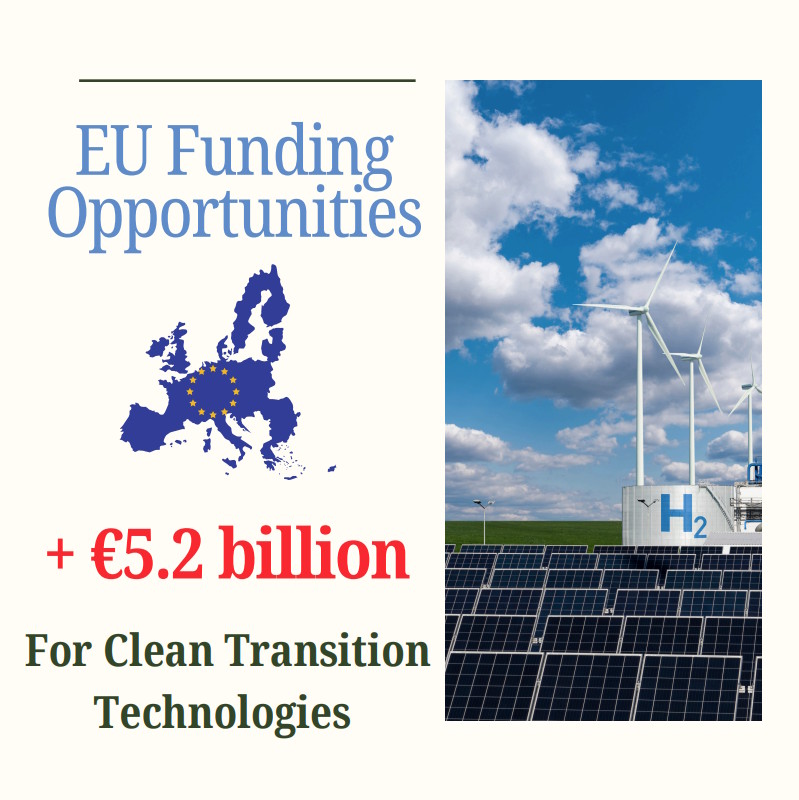
πŸš€ On 4 December 2025, the European Commission has launched three major new funding opportunities under the EU Innovation Fund, mobilising €5.2 billion from EU ETS revenues to support the scale-up of net-zero technologies, clean hydrogen production, and industrial heat decarbonisation.

βœ… Main Funding Opportunities:

πŸ”Ή IF25 Net-Zero Technologies Call – €2.9 billion

πŸ“Œ Supporting innovative, mature decarbonisation projects across various scales, including manufacturing of components for:

  • Renewables & energy storage
  • Heat pumps
  • Hydrogen production
  • EV batteries

πŸ“Œ Projects are assessed on GHG reduction potential, innovation, maturity, replicability, and cost efficiency.

πŸ“Œ A new bonus point is introduced for projects led exclusively by SMEs, recognising their role in driving innovation.

πŸ“… Info Day: 16 December 2025

πŸ”Ή 3rd Auction of the European Hydrogen Bank – €1.3 billion

πŸ“Œ Scaling up production of RFNBO hydrogen and electrolytic low-carbon hydrogen, including a new topic for aviation and maritime off-takers.

πŸ“Œ Support is provided via a fixed premium per kg of verified hydrogen produced for up to 10 years, increasing price certainty and bankability for projects.

πŸ“… Info Day: 10 December 2025

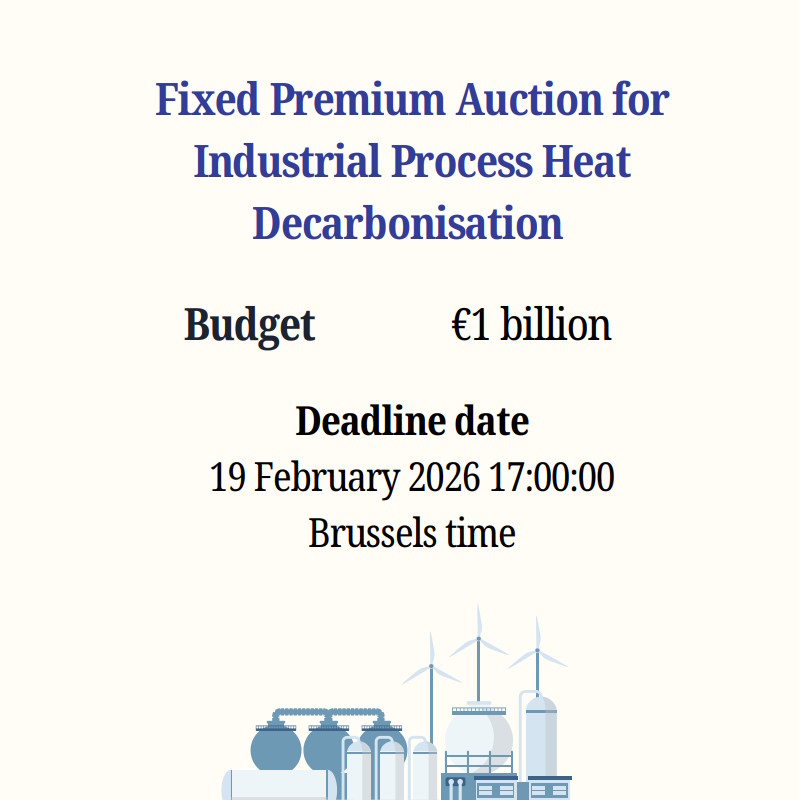
πŸ”Ή 1st Auction for Decarbonising Industrial Process Heat – €1 billion

πŸ“Œ The auction dedicated to industrial process heat, targeting one of Europe’s largest unaddressed emissions sources.

πŸ“Œ Supported technologies include:

  • Heat pumps & electric boilers
  • Resistance & induction heating
  • Solar thermal & geothermal heat
  • Hybrid solutions

πŸ“Œ Funding is granted as a fixed premium per unit of verified decarbonised heat for up to 5 years, awarded to the most cost-effective COβ‚‚ abatement projects.

πŸ“… Info Day: 16 December 2025

Member States can complement EU funding for high-scoring projects that miss out due to budget limits:

πŸ“Œ Germany: additional €1.3 billion for RFNBO hydrogen projects

πŸ“Œ Spain: €465 million total:

  • €415 millionΒ for hydrogen
  • €50 millionΒ for industrial heat decarbonisation

β˜‘οΈ What’s next?

πŸ“Œ Applicants are strongly encouraged to attend the Info Day.

πŸ“Œ Signing of grant agreements:

  • NZT projects – expected Q1 2027
  • Auction projects – within 9 months of call closure.
➑️ Source: €5.2 billion of EU Emissions Trading revenues earmarked for clean transition technologies under the Innovation Fund

New Technologies in the Energy Sector

In October 2025, the U.S. Department of Energy (DOE) released its Fusion Science and Technology Roadmap

In October 2025, the U.S. Department of Energy (DOE) released its Fusion Science and Technology Roadmap, a national strategy to accelerate the development and commercialization of fusion energy on the most rapid, responsible timeline in history.

➑️ Source: Energy Department Announces Fusion Science and Technology Roadmap to Accelerate Commercial Fusion Power

βœ… What is Nuclear Fusion?

  • Nuclear fusion is the process where two light atomic nuclei combine to form a heavier one, releasing massive amounts of energy.
  • Fusion reactions occur in plasma, a hot, charged gas of ions and free electrons with properties distinct from solids, liquids, or gases.
  • The Sun and all stars are powered by this reaction.

➑️ Source: What is Nuclear Fusion?

β˜‘οΈ Key Takeaways:

πŸ“Œ The Roadmap guides the emerging U.S. fusion private sector toward maturity, targeting actions and milestones through the mid-2030s.

πŸ“Œ Build-Innovate-Grow is DOE’s new strategy to support fusion energy commercialization in the U.S. and its tool is the Roadmap.

πŸ“Œ The Roadmap defines a new era of U.S. fusion energy leadership by setting ambitious goals to deliver fusion power on an aggressive timeline, accelerated by the revolutionary potential of Artificial Intelligence (AI)-Fusion convergence.

πŸ“Œ The Roadmap defines Key Actions to be executed in the near-term (next 2-3 years), mid-term (3-5 years) and long-term (5-10 years), aligned to the Build-Innovate-Grow strategy. DOE will build Fusion Science & Technology infrastructure and the AI-Fusion digital convergence platform.

βœ… Is this A New Era of U.S. Fusion Energy Leadership?

πŸ“Œ The U.S. has led innovation in nuclear fusion since the 1940s with significant fusion research carried out during the Manhattan Project.

πŸ“Œ In the 1950s, the U.S. launched Project Matterhorn under the Atomic Energy Commission (AEC), an effort that later became part of the DOE fusion program.

πŸ“Œ The theoretical framework for compressing and heating fusion fuel using powerful energy drivers was also established through early work in the 1960s and 1970s.

πŸ“Œ Since the early 1990s, the U.S. developed some of the world’s most sophisticated multi-physics computational codes validated with world-leading diagnostic tools on world-class domestic facilities.

πŸ“Œ In the 2000s, fusion technology activity began to grow modestly in the U.S. under the APEX and ALPS programs.

πŸ“Œ In the 2010s the advent of high-performance computing and the understanding of burning plasma physics ushered in a predictive capability that has brought forth confidence in a path forward to the commercialization of fusion energy.

πŸ“Œ Today, the U.S. hosts the fastest-growing private fusion sector, attracting $9B+ in private investment and home to 29 fusion companies, the largest globally, including three with over $1B each.

Tax incentives to promote clean technologies

Council of the European Union approved conclusions on the use of tax incentives to promote clean technologies

On 10 October, the Council of the European Union approved conclusions on the use of tax incentives to promote clean technologies and industry, supporting the implementation of the Clean Industrial Deal (CID).

➑️ The conclusions is available via this link.

The conclusions respond to the European Commission’s Recommendation of 2 July 2025, which outlined how Member States can use fiscal tools such as targeted tax credits and accelerated depreciation to boost investment in clean technologies and industrial decarbonisation.

βœ… Key elements of the Council conclusions:

πŸ“Œ Welcome the the Commission recommendation on tax incentives to support the Clean Industrial Deal and in light of the Clean Industrial Deal State Aid Framework.

πŸ“Œ Emphasise that tax incentives should remain simple, effective, and adapted to diverse national tax systems.

πŸ“Œ Highlight the importance of flexibility and Member State discretion in designing and applying incentives, given budgetary realities.

πŸ“Œ Encourage evaluation and exchange of best practices across Member States to ensure effective implementation.

β˜‘οΈ Why this matters:

Tax incentives can become a cornerstone of Europe’s industrial transformation, helping to:

  • Stimulate private investment in decarbonisation and clean manufacturing;
  • Improve cash flow for businesses investing in energy efficiency and renewables;
  • Strengthen the EU’s industrial base while supporting the 2050 climate neutrality goal.

By aligning tax policy with the Clean Industrial Deal and State aid rules, the EU is laying the groundwork for a coherent fiscal framework that empowers industries to lead the clean transition cost-effectively and competitively.

EU Startup and Scaleup Strategy

EU Startup and Scaleup Strategy

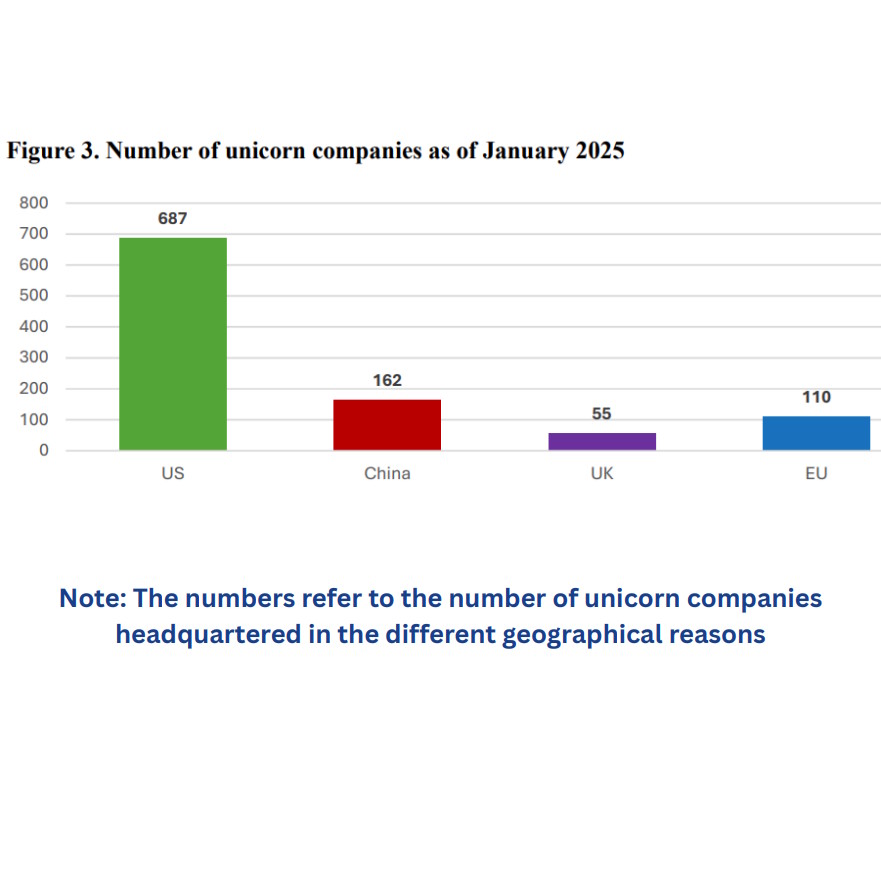
On 28 May 2025, the European Commission has launched the EU Startup and Scaleup Strategy, to make Europe a great place to start and grow global technology-driven companies.

βœ… The EU Startup and Scaleup Strategy aims to make Europe the best place in the world to launch and grow global technology-driven companies, including deep tech companies. This is crucial for strategic technologies, such as for example cleantech and energy (including nuclear technology).

β˜‘οΈ The key needs of startups and scaleups:

πŸ“Œ Fostering innovation-friendly environment:

  • Startups and scaleups need less fragmentation, fewer administrative burdens, as well as rules that are simpler and more supportive across the Single Market.
  • a European 28th regime will be proposed to simplify rules and reduce the cost of failure by addressing critical aspects in areas like insolvency, labour and tax law.
  • The European Business Wallet will enable seamless digital interactions with public administrations across the EU through a unified digital identity for all economic operators.
  • The forthcoming European Innovation Act will further support innovation by promoting regulatory sandboxes.

πŸ“Œ Driving better financing:

  • The Savings and Investments Union initiative will be key to unlocking more financing and investment opportunities in the EU.
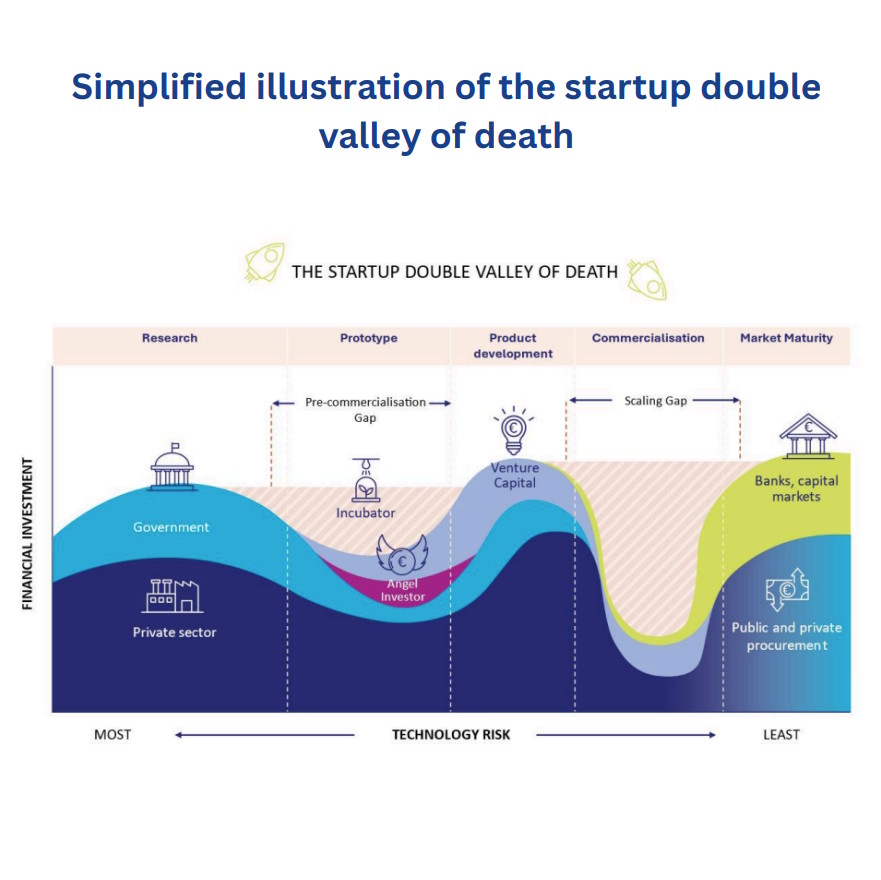
  • The Strategy aims to expand and simplify the European Innovation Council, deploy a Scaleup Europe Fund to help bridge the financing gap of deep tech scale-up companies, and develop a voluntary European Innovation Investment Pact to mobilise large institutional investors to invest in EU funds, venture capital funds and unlisted scaleups.

πŸ“Œ Supporting market uptake and expansion:

  • The Strategy introduces a Lab to Unicorn initiative, which includes the European Startup and Scaleup Hubs.

πŸ“Œ Attracting and retaining top talent:

  • The Strategy introduces the Blue Carpet initiative, notably focusing on entrepreneurial education, tax-related aspects of employee stock options and cross-border employment.
  • The Blue Card Directive will be promoted to put in place a fast-track schemes for non-EU founders.

πŸ“Œ Facilitating access to infrastructure, networks and service:

  • The Strategy proposes to simplify and harmonise diverging access and contractual conditions for startups and scaleups to technology and research infrastructures through a Charter of Access for industrial users.

➑️ Source: Commission launches ambitious Strategy to make Europe a startup and scaleup powerhouse