The Energy Transition Investment Trends Report
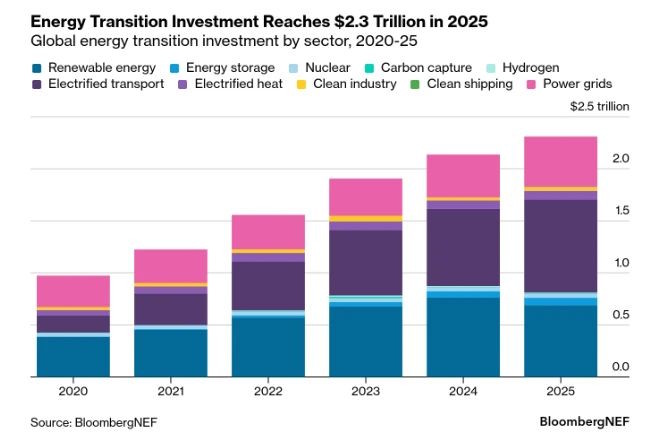
BloombergNEF. Global energy transition investment by sector, 2020-2025

Figure: Global energy transition investment by sector, 2020-2025

Source: BloombergNEF

The Energy Transition Investment Trends (ETIT) Report, released by BloombergNEF (BNEF), finds that global investment in the energy transition reached a record $2.3 trillion in 2025, up 8% from the prior year.

✅ Main Takeaways:

📌 The largest investment drivers were:

  • electrified transport – $893 billion;
  • renewable energy – $690 billion;
  • grid investment – $483 billion.

📌 Renewable energy investment fell 9.5% year-on-year due to changing power market regulations in China.

📌 Hydrogen ($7.3 billon) and nuclear ($36 billion) saw investment drop in 2025. All other sectors grew: energy storage ($71 billion), CCS ($6.6 billion), clean shipping ($4.2 billion), electrified heat ($84 billion) and clean industry ($34 billion).

📌 Clean energy supply investment outpaced fossil fuel supply for a second consecutive year in 2025, with the gap widening to $102 billion from $85 billion in 2024.

📌 While clean energy investment continued to grow, fossil fuel supply investment fell for the first time since 2020, declining by $9 billion year-on-year.

📌 Despite energy transition investment being at an all-time high, growth has slowed steadily, from 27% in 2021 to 8% in 2025.

📌 The regional changes:

  • China ($800 billion) is posting its first decline in investment since 2013.
  • The EU shrugged off headwinds to grow 18% to $455 billion, contributing the most to the global uptick.
  • US investment also moved up 3.5% to $378 billion, despite the Trump administration’s moves to slow the energy transition.

➡️ Source: BloombergNEF Finds Global Energy Transition Investment Reached Record $2.3 Trillion in 2025, Up 8% from 2024

Fitness Check on EU Energy Security

The European Commission has just published a ‘fitness check’ of EU legislation on electricity and gas security of supply, looking both at past performance and what lies ahead. The document acknowledges that energy security in the EU will look very different in a decarbonised, electrified and geopolitically changed energy system.

✅ Key future developments include:

  • The evolving role of electricity and natural gas in a highly electrified, integrated energy system.
  • Protecting consumers and critical energy needs amid electrification and the phase-out of natural gas.
  • The growing role of new energy carriers such as biomethane and hydrogen.
  • Diversification of supply in response to geopolitical shifts and a stronger focus on homegrown clean energy.
  • The importance of critical raw materials for resilient clean-tech supply chains.
  • The increasing impact of climate change on EU energy security.

☑️ These points are clarified by the following:

📌 The energy transition will have a profound effect on the future security of gas and electricity supply. Phasing out imported fossil fuels and instead relying on homegrown renewable energy sources will have a substantial positive impact on the EU’s energy security. At the same time, a more electrified and decarbonised energy system requires a different management approach, with greater flexibility.

📌 Biomethane will become increasingly relevant for energy security. Under the Hydrogen and Decarbonised Gas Package, biomethane is now explicitly included in the definition of “natural gas”, meaning the Gas Security of Supply Regulation will apply to it from 2025 onwards. However, biomethane has very different characteristics compared to fossil gas: seasonal production, strong reliance on local resources, and predominantly decentralised injection into distribution grids. Importantly, biomethane-fired generation is still expected to contribute to electricity security by 2050 by providing flexible backup for variable renewables.

📌 Hydrogen will also become important for the future energy security framework, particularly for hard-to-abate sectors, and as a source of flexibility for the power system. Long-term storage, e-gases and e-fuels can all support security of supply. However, hydrogen will not simply “replace” natural gas. Its system role will be fundamentally different, and the deployment of electrolysers must be carefully aligned with grid capacities and broader decarbonisation pathways.

Overall, this ‘fitness check’ makes one thing very clear:

  • Energy security is no longer just about conventional fuels;
  • Energy security is about system design, flexibility, resilience, and smart regulation.

➡️ Source: Commission publishes “fitness check” on EU laws covering the security of electricity and gas supply in view of future revision

Modernisation Fund

On 17 December 2025, the European Commission and the European Investment Bank announced the disbursement of €1.8 billion from the Modernisation Fund to support 45 clean energy-related investments in 12 different Member States, including Portugal, which became a beneficiary Member State in 2024.

Financed by revenues from the EU Emissions Trading System (EU ETS), this brings total Modernisation Fund support to €20.7 billion for 294 investments since 2021. In 2025 alone, €5.46 billion has been disbursed to 79 projects, following an earlier allocation of €3.66 billion in July.

✅ What is the Modernisation Fund?

📌 The Modernisation Fund, funded by revenues from the auctioning of emission allowances under the EU ETS, aims to support 13 lower-income EU countries in their transition to climate neutrality.

📌 The beneficiary Member States are Bulgaria, Croatia, Czechia, Estonia, Hungary, Latvia, Lithuania, Poland, Romania, and Slovakia, as well as Greece, Portugal and Slovenia which became eligible for support as of January 2024, under the revised EU ETS Directive.

📌 The Modernisation Fund supports investments in the generation and use of energy from renewable sources, energy efficiency, energy storage, modernisation of energy networks, including district heating, grids, and just transition in carbon-dependent regions.

📌 It operates under the responsibility of the beneficiary countries in close cooperation with the European Commission and the European Investment Bank.

📅 Next deadlines

The next deadlines for beneficiary Member States to submit investment proposals under the Modernisation Fund are:

  • 15 January 2026 for non-priority proposals
  • 12 February 2026 for priority proposals.

➡️ Source: Joint press release: Modernisation Fund announces €1.8 billion in new clean energy investments, bringing 5-year total to over €20 billion

2025 Carbon Market Report

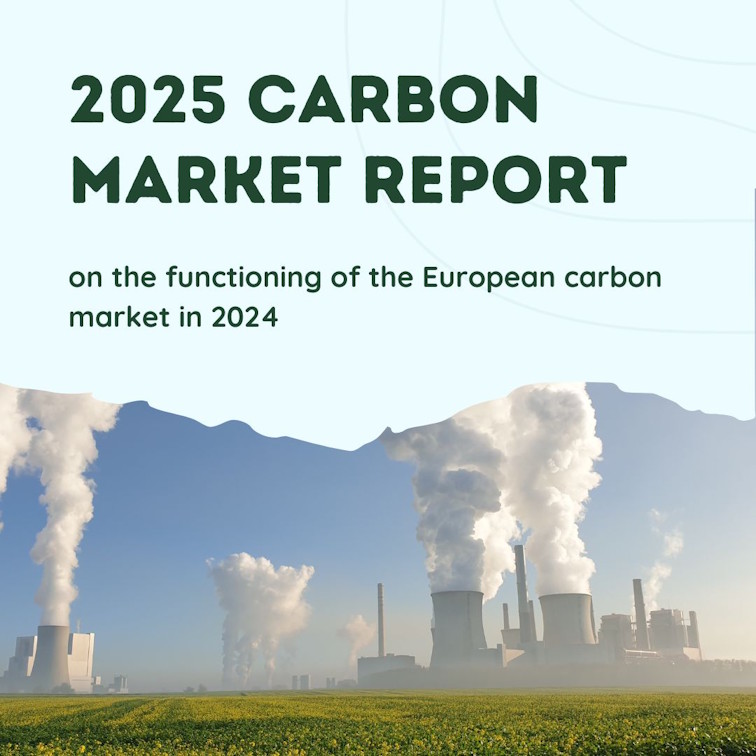
2025 Carbon Market Report on the functioning of the European carbon market in 2024

On 3 December 2025, the European Commission published the 2025 Carbon Market Report, confirming that the EU Emissions Trading System (EU ETS) continues to function effectively and remains a key pillar of Europe’s climate policy.

As part of the State of the Energy Union Report, the assessment:

▪️ Reviews EU ETS performance in 2024 and early 2025
▪️ Confirms the continued decline in emissions across power and industry.

✅ Key takeaways:

🔹 Overall progress

  • EU ETS emissions from power and industry are now around 50% below 2005 levels.
  • The system remains on track for the 2030 target: –62% emissions

🔹 Power & Industry

  • 2024 emissions from power installations fell by almost 11% compared to 2023
  • Overall fuel combustion emissions across power + industry declined by 9%

🔹 Aviation

  • EU ETS prices for intra-European aviation increased around 15% in 2024
    • ➡️ Key Drivers: continued growth in aviation emissions and expanded coverage, including flights to the EU’s outermost regions
  • The EU ETS also started rewarding airlines for their use of sustainable aviation fuels (SAF) through additional allowance allocation, and the EU became the first jurisdiction to introduce monitoring and reporting of non-CO2 aviation effects.
  • SAF incentives under EU ETS
    • The ETS carbon price already provides an incentive of around EUR 200 per tonne of SAF used, compared to fossil kerosene.
    • Additional ETS support measures implemented in 2025: €500 – €7,000 per tonne of eligible SAF on ETS routes and applicable since 1 January 2024.
    • For 2024, the incentive from EU ETS was worth around EUR 25 million, supplemented by ETS support of about 1.3 million allowances worth approximately EUR 100 million
  • CORSIA alignment
    • Limited intra-European EU ETS scope extended to end-2026
    • Full application of ICAO CORSIA expected from 2027

🔹 Maritime

  • 2024 marked the inclusion of shipping in the EU ETS
  • Coverage:
    • 100% of emissions between EEA ports & at EEA ports
    • 50% of emissions from voyages to/from non-EEA ports
  • Compliance was high: shipping companies surrendered allowances for more than 99% of their relevant surrendering requirements by the 30 September deadline.
  • In 2025, shipping companies surrendered allowances for 40% of their 2024 emissions

🔹 EU ETS funding the clean transition

  • €38.8 billion raised in 2024
  • Revenues support:
    • National climate action
    • Clean energy investments
    • Innovation Fund
    • Modernisation Fund
    • Recovery & Resilience Facility (REPowerEU)

☑️ Total ETS revenues now exceed €250 billion

➡️ Source: 2025 Carbon Market Report: EU ETS lowers power sector emissions and expands to maritime transport

Small Modular Reactors – Future Development and Deployment in Europe

Public consultation. Small Modular Reactors. Future development and deployment in Europe

📢 Call for Evidence: “Small Modular Reactors – Future Development and Deployment in Europe”

On 6 November, the European Commission launched a public consultation to help shape the upcoming EU Strategy on Small Modular Reactors (SMRs).

🗓️ Open until: 4 December 2025

➡️ Participate here: Small modular reactors – future development and deployment in Europe

✅ What is this initiative about?

📌 The Commission plans to adopt an SMR Strategy in Q1 2026 (via a Commission Communication) aimed at creating a supportive industrial, economic, and policy framework to accelerate SMR deployment across Europe with first projects expected in the early 2030s.

📌 The strategy seeks to:

  • Strengthen the competitiveness of the EU industry;
  • Foster innovation in nuclear technologies;
  • Provide a coherent EU approach, complementing national initiatives.

☑️ Why does it matter?

📌 More than 10 EU Member States have already expressed interest in deploying SMRs as part of their national energy and climate plans.

📌 SMRs are seen as a potential source of clean, flexible electricity and heat for residential and industrial use, including low-carbon hydrogen and efuel production.

📌 Key advantages include simplified design, enhanced safety features, factory production, reduced construction and operational costs, flexibility for multiple energy uses, and contributions to grid stability.

✅ Strategy objectives:

Building on the work of the European Industrial Alliance on SMRs, the upcoming Communication will focus on:

  • Strengthening collaboration to develop a robust EU supply chain
  • Enhancing regulatory cooperation and streamlining licensing processes
  • Reinforcing EU leadership in research and innovation, including start-up and scale-up partnerships
  • Securing a reliable nuclear fuel cycle
  • Preserving and developing skills and expertise across Europe
  • Addressing investment barriers
  • Supporting public engagement and trust-building initiatives

New Technologies in the Energy Sector

In October 2025, the U.S. Department of Energy (DOE) released its Fusion Science and Technology Roadmap

In October 2025, the U.S. Department of Energy (DOE) released its Fusion Science and Technology Roadmap, a national strategy to accelerate the development and commercialization of fusion energy on the most rapid, responsible timeline in history.

➡️ Source: Energy Department Announces Fusion Science and Technology Roadmap to Accelerate Commercial Fusion Power

✅ What is Nuclear Fusion?

  • Nuclear fusion is the process where two light atomic nuclei combine to form a heavier one, releasing massive amounts of energy.
  • Fusion reactions occur in plasma, a hot, charged gas of ions and free electrons with properties distinct from solids, liquids, or gases.
  • The Sun and all stars are powered by this reaction.

➡️ Source: What is Nuclear Fusion?

☑️ Key Takeaways:

📌 The Roadmap guides the emerging U.S. fusion private sector toward maturity, targeting actions and milestones through the mid-2030s.

📌 Build-Innovate-Grow is DOE’s new strategy to support fusion energy commercialization in the U.S. and its tool is the Roadmap.

📌 The Roadmap defines a new era of U.S. fusion energy leadership by setting ambitious goals to deliver fusion power on an aggressive timeline, accelerated by the revolutionary potential of Artificial Intelligence (AI)-Fusion convergence.

📌 The Roadmap defines Key Actions to be executed in the near-term (next 2-3 years), mid-term (3-5 years) and long-term (5-10 years), aligned to the Build-Innovate-Grow strategy. DOE will build Fusion Science & Technology infrastructure and the AI-Fusion digital convergence platform.

✅ Is this A New Era of U.S. Fusion Energy Leadership?

📌 The U.S. has led innovation in nuclear fusion since the 1940s with significant fusion research carried out during the Manhattan Project.

📌 In the 1950s, the U.S. launched Project Matterhorn under the Atomic Energy Commission (AEC), an effort that later became part of the DOE fusion program.

📌 The theoretical framework for compressing and heating fusion fuel using powerful energy drivers was also established through early work in the 1960s and 1970s.

📌 Since the early 1990s, the U.S. developed some of the world’s most sophisticated multi-physics computational codes validated with world-leading diagnostic tools on world-class domestic facilities.

📌 In the 2000s, fusion technology activity began to grow modestly in the U.S. under the APEX and ALPS programs.

📌 In the 2010s the advent of high-performance computing and the understanding of burning plasma physics ushered in a predictive capability that has brought forth confidence in a path forward to the commercialization of fusion energy.

📌 Today, the U.S. hosts the fastest-growing private fusion sector, attracting $9B+ in private investment and home to 29 fusion companies, the largest globally, including three with over $1B each.

World Energy Outlook 2025

International Energy Agency. World Energy Outlook 2025

☑️ The World Energy Outlook 2025 (WEO-2025) of International Energy Agency considers the following scenarios:

📌 Current Policies Scenario (CPS): A snapshot of policies and regulations that are already in place.

📌 Stated Policies Scenario (STEPS): Encompasses a broader range of policies, including those that have been formally proposed but not yet adopted, as well as other official strategy documents that indicate the intended direction of policy.

📌 Net Zero Emissions by 2050 Scenario (NZE Scenario): Describes a pathway to reduce global energy-related CO₂ emissions to net zero by 2050, while recognising that each country will follow its own route.

☑️ Key Takeaways

📌 Electricity

  • Electricity demand grows much faster than overall energy use in all scenarios: it rises by around 40% to 2035 in both the CPS and the STEPS, and by more than 50% in the NZE Scenario.
  • Electricity currently accounts for only 21% of total final energy consumption globally, yet it is the key energy source for sectors representing over 40% of the global economy, and the main energy source for most households.
  • A pivotal issue for electricity security is the pace at which new grids, storage facilities, and other sources of power system flexibility are developed.
  • Investments in electricity generation have surged by almost 70% since 2015, reaching USD 1 trillion per year, while annual grid spending has increased at less than half that pace to around USD 400 billion.
  • The explosive growth in electricity demand for data centres and AI is concentrated in advanced economies and China. Investment in data centres is expected to reach USD 580 billion in 2025. A tripling of electricity consumption by data centres by 2035 will represent less than 10% of total global electricity demand growth, but it will be highly concentrated geographically. More than 85% of new data centre capacity additions over the next ten years are expected in the United States, China, and the European Union.

📌 Renewables

  • Renewables grow faster than any other major energy source in all scenarios, led by solar photovoltaics.

📌 Nuclear Power

  • Another common element across scenarios is the revival of nuclear energy, with investment rising in both traditional large-scale plants and new designs, including small modular reactors (SMRs).
  • More than 40 countries now include nuclear energy in their strategies and are taking steps to develop new projects.

➡️ Source: International Energy Agency. World Energy Outlook 2025

IEA Report: Delivering Sustainable Fuels

International Energy Agency. Report. Delivering Sustainable Fuels. Pathways to 2035

Sustainable fuels mean liquid biofuels, biogases, low-emissions hydrogen and hydrogen-based fuels – offer multiple benefits for the energy sector.

With well-designed policies, sustainable fuels can achieve major lifecycle emissions reductions compared with conventional fuels.

✅ IEA Policy Recommendations:

📌 Establish roadmaps, targets and support policies that are tailored to regional contexts and aligned with broader energy goals, while keeping a technology-open approach.

📌 Increase demand predictability to increase market confidence and attract investment.

📌 Cooperate in developing transparent and robust carbon accounting methodologies to enhance comparability and future interoperability, and enable performance-based policies and incentives.

📌 Support innovation to narrow cost gaps to accelerate economies of scale and cost reductions for emerging technologies.

📌 Develop integrated supply chains and address infrastructure needs to unlock long-term economic development opportunities.

📌 Make financing more accessible, especially in emerging and developing economies to de-risk investment and unlock the vast potential for sustainable fuels in these regions.

➡️ Source: International Energy Agency. Report. Delivering Sustainable Fuels. Pathways to 2035

New draft laws in the Energy Sector

Abolition of the gas storage levy - Entwurf eines Vierten Gesetzes zur Änderung des Energiewirtschaftsgesetzes.
Accelerate the Expansion of Geothermal Plants, Heat Pumps, and Heat Storage Facilities - Entwurf eines Gesetzes zur Beschleunigung des Ausbaus von Geothermieanlagen, Wärmepumpen und Wärmespeichern sowie zur Änderung weiterer rechtlicher Rahmenbedingungen für den klimaneutralen Ausbau der Wärmeversorgung.
EU Renewable Energy Directive in the Areas of Offshore Wind Energy and Electricity Grids - Entwurf eines Gesetzes zur Umsetzung der EU-Erneuerbaren-Richtlinie
in den Bereichen Windenergie auf See und Stromnetze.
Act Amending Energy Industry Law to Strengthen Consumer Protection in the Energy Sector and Amending Other Energy Law Provisions (EnWG Amendment 2025) - Entwurf eines Gesetzes zur Änderung des Energiewirtschaftsrechts zur
Stärkung des Verbraucherschutzes im Energiebereich sowie zur Änderung weiterer energierechtlicher Vorschriften.

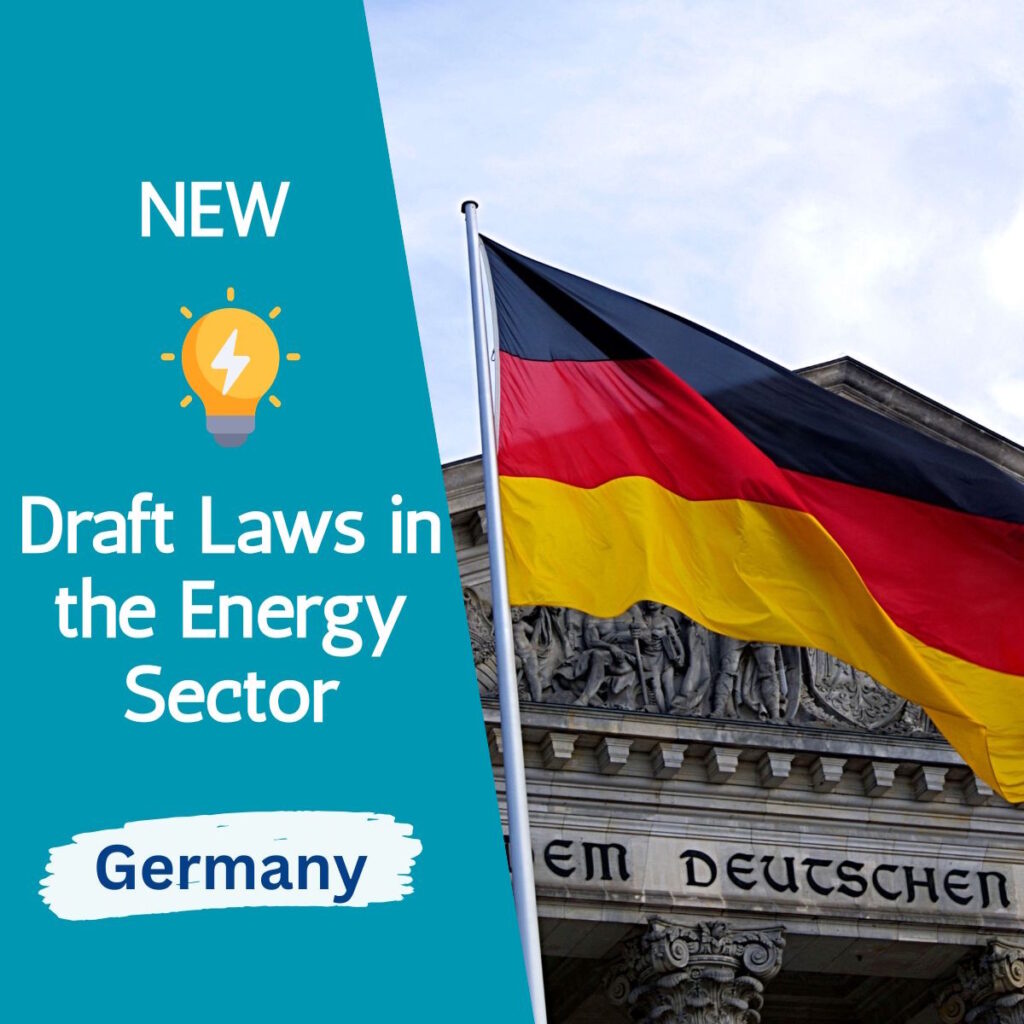
On 6 August, the German Government launched the following drafts of laws initiated by the Federal Ministry for Economic Affairs and Energy:

✅ Abolition of the gas storage levy

📄 Draft of a Fourth Law Amending the Energy Industry Act – Entwurf eines Vierten Gesetzes zur Änderung des Energiewirtschaftsgesetzes

📌 An important initiative from the coalition agreement and the emergency program.

📌 This Draft Law will provide relief for all end customers.

📌 The relief to all end customers will be in the amount of approximately €3.4 billion:

  • with a levy of €2.89 per megawatt hour, the relief for a four-person household will amount to approximately €30 to €60 per year.
  • the relief on gas prices will also contribute to a reduction in electricity costs.

✅ Draft Law to Accelerate the Expansion of Geothermal Plants, Heat Pumps, and Heat Storage Facilities

📄 Draft Law: Entwurf eines Gesetzes zur Beschleunigung des Ausbaus von Geothermieanlagen, Wärmepumpen und Wärmespeichern sowie zur Änderung weiterer rechtlicher Rahmenbedingungen für den klimaneutralen Ausbau der Wärmeversorgung

📌 Planning approval procedures for heat pipelines and the construction of large heat pumps will be accelerated.

📌 The approval process for heat storage facilities will be clearly regulated, thereby eliminating uncertainty in practice.

📌 In the future, authorities will be able to require geothermal companies to provide proof of coverage for mining damage as well.

✅ Law Implementing the EU Renewable Energy Directive in the Areas of Offshore Wind Energy and Electricity Grids

📄 Draft Law: Entwurf eines Gesetzes zur Umsetzung der EU-Erneuerbaren-Richtlinie in den Bereichen Windenergie auf See und Stromnetze

📌 Introduction of acceleration areas for offshore wind energy and infrastructure areas for transmission grids, distribution grids, and offshore connection lines.

📌 Streamlined approval procedures are to apply to these areas.

📌 The draft transposes the requirements of the RED III in the areas of offshore wind energy and electricity grids into national law.

✅ Act Amending Energy Industry Law to Strengthen Consumer Protection in the Energy Sector and Amending Other Energy Law Provisions (EnWG Amendment 2025)

📄 Draft Law: Entwurf eines Gesetzes zur Änderung des Energiewirtschaftsrechts zur Stärkung des Verbraucherschutzes im Energiebereich sowie zur Änderung weiterer energierechtlicher Vorschriften

📌 The Draft Law further increases the level of protection for consumers in the energy sector through obligations of electricity suppliers to household customers to hedge against price risks.

📌 The new regulations on “energy sharing” will enable consumers to actively participate in the energy market and the energy transition.

📌 The Draft Law provides for a further acceleration of the smart meter rollout.

AI & Energy

Artificial Intelligence and digitalisation for Energy

📢 New EU Initiative on AI & Energy

The European Commission has launched the public consultations regarding the initiative “Strategic Roadmap for digitalisation and AI in the energy sector”.

🗓 Feedback period: 05 August 2025 – 05 November 2025

💬 Feedback can be provided here

🎯 Goals of the Strategic Roadmap:

📌 To exploite of synergies with the Affordable Energy Action Plan, the Energy Efficiency Roadmap, the Grids Package, the Citizens Energy Package, the Electrification Action Plan and the Heating and Cooling Strategy.

📌 To complement the upcoming Apply AI Strategy, the Data Union Strategy, and the Cloud and AI Development Act.

📌 To leverage the potential of digital and AI technologies for the energy system, while mitigating the associated risks and enable the decarbonisation and competitiveness of the EU economy.

☑️ What does the initiative aim to achieve?

📌 Accelerate deployment

  • Enable access to energy data to support innovative services
  • Help develop and test AI tools for the energy sector
  • Advance smart grids and digital twins

📌 Boost innovation & research

  • Close the innovation gap
  • Strengthen EU technological sovereignty
  • Support clean energy R&D using AI

📌 Integrate data centers sustainably

  • Improve planning and energy efficiency
  • Minimise grid strain and local impact

📌 Enhance transparency & risk oversight

  • Share best practices for AI in critical infrastructure
  • Provide guidance on high-risk AI systems
  • Use AI to improve energy asset security

📌 Create a robust governance framework

  • Foster collaboration across sectors and Member States
  • Engage with international partners and stakeholders

✅ What next?

  • Targeted consultations and workshops
  • Discussions with Member States and expert groups
  • A high-level stakeholder event in Q3 2025

➡️ Source: Artificial intelligence and digitalisation for energy – a roadmap