Amendments to the EU Climate Law

Amendment to the EU Climate Law by the European Commission

On 2 July 2025, the European Commission proposed an amendment to the EU Climate Law, introducing a 2040 climate target:

โœ… 90% reduction in net GHG emissions by 2040, compared to 1990 levels.

๐Ÿ“„ Proposal for a 2040 EU climate target is available via this link.

โ˜‘๏ธ Main Proposals:

To support the achievement of the 2040 EU climate target, the European Commission will ensure that future legislative proposals appropriately reflect a broad set of guiding principles and priorities, including:

๐Ÿ“Œ Starting from 2036, high-quality international credits (up to 3% of 1990 emissions) under Article 6 of the Paris Agreement, supporting both EU and global efforts to stay below a 1.5ยฐC temperature rise.

๐Ÿ“Œ The role of domestic permanent removals within the EU ETS to address residual emissions in hard-to-abate sectors.

๐Ÿ“Œ Enhanced flexibility across sectors for cost-effective progress.

๐Ÿ“Œ Use of the best available science, including IPCC and Advisory Board reports.

๐Ÿ“Œ Consideration of social, economic, and environmental impacts, the costs of inaction, and the benefits of action over the medium and long term.

๐Ÿ“Œ Ensuring a just and socially fair transition for all.

๐Ÿ“Œ Promoting technology neutrality, simplification, economic efficiency, and security.

๐Ÿ“Œ Positioning climate action as a driver for investment and innovation.

๐Ÿ“Œ Strengthening the global competitiveness of EU industries, especially SMEs and sectors most exposed to carbon leakage.

๐Ÿ“Œ Supporting affordable and secure energy, efficiency, and the energy efficiency first principle.

๐Ÿ“Œ Maintaining and enhancing natural carbon sinks and protecting biodiversity.

๐Ÿ“Œ Addressing investment needs and financing opportunities.

๐Ÿ“Œ Aligning with international efforts under the Paris Agreement and the UNFCCC.

โœ… Next Steps:

The proposal will be submitted to the European Parliament and the Council for discussion and adoption under the ordinary legislative procedure.

โžก๏ธ Source: EU’s Climate Law presents a new way to get to 2040
EEA report

Renewables, electrification and flexibility โ€” for a competitive EU energy system transformation by 2030

Renewables, electrification and flexibility - For a competitive EU energy system transformation by 2030

The EEA report โ€˜Renewables, electrification and flexibility โ€” for a competitive EU energy system transformation by 2030โ€™.

โœ… Key Insights:

๐Ÿ“Œ The EU has made remarkable progress in cutting electricity-sector CO2 emissions over recent decades. However, decarbonising heating and transport โ€” still dominated by gas and oil โ€” lags behind.

๐Ÿ“Œ Scaling up domestic renewable electricity generation, together with improvements in energy and resource efficiency, can replace volatile fossil fuel imports with cleaner, lower-cost energy.

๐Ÿ“Œ If 2030 renewables and efficiency targets are met, variable electricity generation costs in the EU could fall by up to 57% compared to 2023 levels. In the long term, this means lower consumer prices, though near-term investments in grid flexibility and infrastructure will be essential.

๐Ÿ“Œ The shift to green hydrogen as an industrial feedstock will significantly increase electricity demand post-2030. By 2050, hydrogen use could rise more than tenfold compared to the end of this decade, with around 65% dedicated to industrial applications.

๐Ÿ“ŒMeeting climate goals requires a rapid decline in fossil fuel use: annual oil reduction must double by 2030, while gas use must fall eightfold. This would cut the fossil energy share from 59% in 2022 to 6% by 2050.

๐Ÿ“Œ Urgent priorities include:

  • Unlocking capital to expand renewable capacity to 77% of total installed capacity by 2030.
  • Doubling system flexibility through smart grids, storage, and demand response.
  • Strengthening EU-wide coordination to balance regional disparities and improve resilience.

โžก๏ธ Source: Renewables, electrification and flexibility – For a competitive EU energy system transformation by 2030

Clean Industrial Solutions and Aid Framework (CISAF)

๐Ÿ“ข On 25 June 2025, the European Commission adopted the Clean Industrial Solutions and Aid Framework (CISAF) โ€” a major step to align State aid rules with the goals of the Clean Industrial Deal.

This new framework provides targeted support for low-carbon fuels, including low-carbon hydrogen, RFNBOs, and synthetic fuels, through structured investment aid schemes.

๐Ÿ”น What’s new for hydrogen and e-fuels?

The European Commission will consider compatible with the internal market aid measures to support:

  • investments for the production of low-carbon fuels
  • investments for the production of RFNBOs
  • investments in storage for low-carbon fuels that store exclusively low-carbon fuels, or a mix of low-carbon fuels and RFNBOs.

๐Ÿ”น Key conditions:

  • 30% of budgets must be reserved for RFNBOs
  • GHG reduction threshold of 70% for low-carbon fuels
  • Aid applies only to new capacity
  • Schemes must remain open, non-discriminatory, and compliant with the ‘Do No Significant Harm’ principle.

โœ… This is a promising signal for project developers and industrial actors across Europe. The CISAF framework may play a critical role in de-risking early investments in the hydrogen economy and scaling up low-carbon fuel production.

โžก๏ธ Source: Clean Industrial Deal State Aid Framework (CISAF)

Hydrogen in the Reformed EU ETS

green and blue hydrogen costs

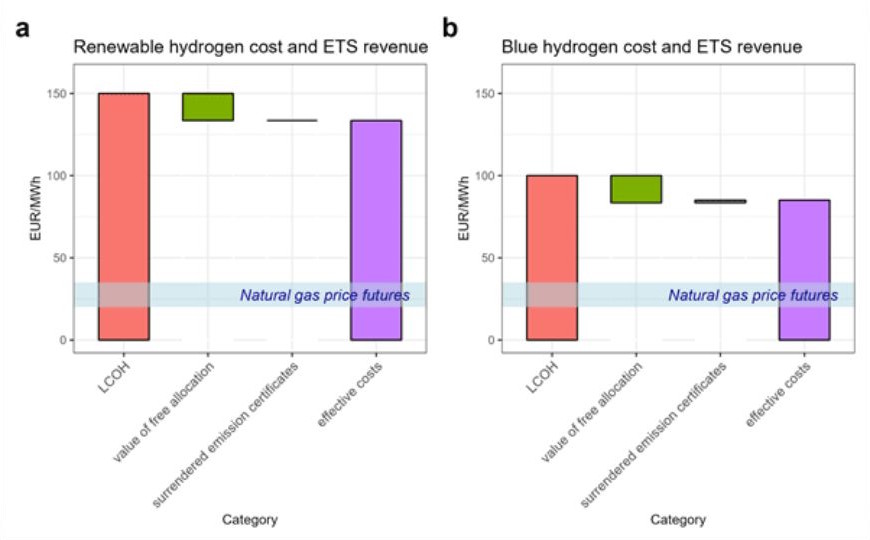
Figure: Comparing green (left) and blue hydrogen (right) costs accounting for EU ETS impacts (assumed CO2 price: 80 โ‚ฌ/tCO2) based on the optimistic end of near-term cost estimates for 2025 to 2030. The value of free allocations is calculated based on CBAM factor of 100 %, which applies until the end of 2025. No additional subsidies considered here.

Source: Nils Bruch, Falko Ueckerdt, Michรจle Knodt (2025): Hydrogen in the Reformed EU ETS โ€“ Implications for Competitiveness and Emissions Reductions. Kopernikus-Projekt Ariadne, Potsdam.

Hydrogen in the Reformed EU ETS: What It Means for Competitiveness and Emissions Reductions?

๐Ÿ”น Key insights:

๐Ÿ“Œ The EU ETS alone cannot make hydrogen competitive.

  • Hydrogen production (both renewable and blue) remains significantly more expensive than natural gas โ€” currently 4 to 6 times more costly.
  • The value of freely allocated ETS allowances does little to close this gap, as illustrated in the picture below with the green part, especially with today’s relatively low COโ‚‚ prices.

๐Ÿ“Œ To bridge the cost gap and enable a fuel switch from natural gas to low-carbon or renewable hydrogen, COโ‚‚ prices of โ‚ฌ300โ€“500/tCOโ‚‚ would be necessary.

๐Ÿ“Œ Switching from blue to green hydrogen would require โ‚ฌ2500/tCOโ‚‚ if only downstream emissions are priced.

โœ… Policy recommendations include:

๐Ÿ“Œ Expanding the EU ETS to cover upstream emissions for a more accurate climate cost signal.

๐Ÿ“Œ Gradually lowering the emission intensity threshold (currently 28.2 gCOโ‚‚eq/MJ) for low-carbon hydrogen to encourage innovation and deeper decarbonisation.

๐Ÿ’ก To use hydrogen for the energy transition, it is essential to go beyond emissions pricing and rethink how to support its competitiveness and climate impact.

IEA World Energy Investment 2025 Report

investment in selected low-emissions fuels in selected regions, 2023, 2024 and 2025

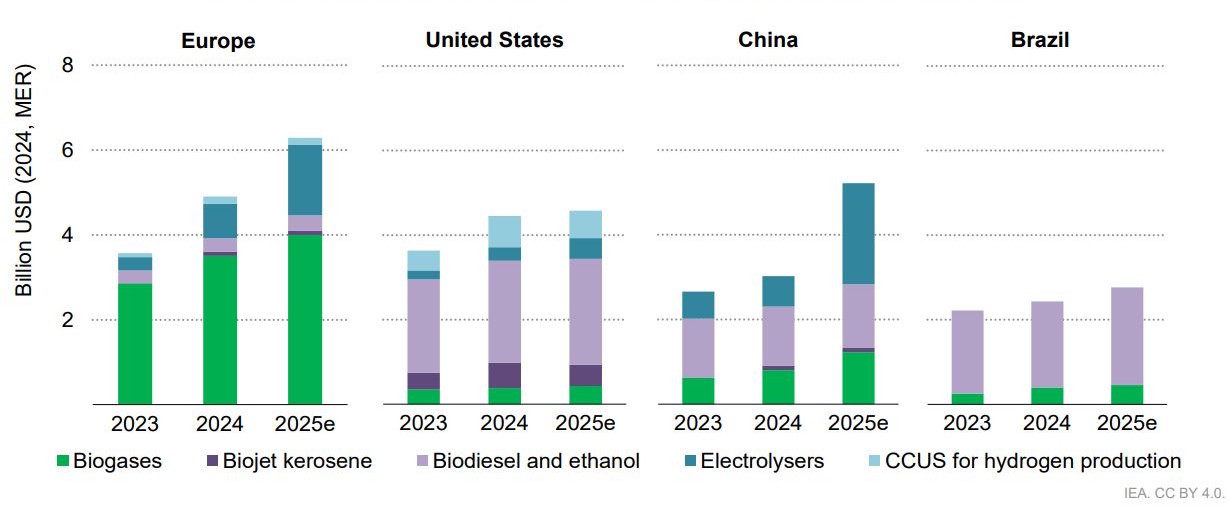
Figure: Investment in selected low-emissions fuels in selected regions, 2023, 2024 and 2025

Source: World Energy Investment 2025 report, 10th Edition

Investment in liquid biofuels, biogases and hydrogen is set to rise by 30 % in 2025, to nearly $25 billion, building on a 20 % rise in 2024.

๐Ÿ“Œ Low-emissions fuel spending varies greatly by region:

  • in 2024, Europe accounted for 60% of global investment in biogases;
  • the US made up 70% of global investment in biojet kerosene;
  • China has large investments in hydrogen;
  • Brazil focuses on liquid biofuels.

๐Ÿ“Œ Investment in liquid biofuels, biogases and low-emissions hydrogen is set to rise by 30% in 2025 to a record high close to USD 25 billion, building on a 20% rise in 2024.

๐Ÿ“Œ Policies and regulations remain essential to this growth: mandates, quotas and other forms of policy support have underpinned the high levels of investment in biodiesel and ethanol in the United States and Brazil and in biogases in Europe.

๐Ÿ“Œ Some hydrogen projects have been cancelled or delayed in the past 12 months, but there remains a pipeline of projects that have received FID, requiring around USD 8 billion of investment in 2025, a 70% increase from the level in 2024.

๐Ÿ“Œ For hydrogen:

  • there were a number of setbacks for projects around the world, nonetheless, investment rose by 60% in 2024, and there remains a large pipeline of hydrogen production projects that have received FID.
  • government support has continued in 2025 globally, for example, in Australia and the EU.
  • all hydrogen projects that have received FID would require investment almost USD 8 billion and would increase capacity to around 7.5 Mt in 2035.

โžก๏ธ Source: World Energy Investment 2025 report, 10th Edition

EU Startup and Scaleup Strategy

EU Startup and Scaleup Strategy

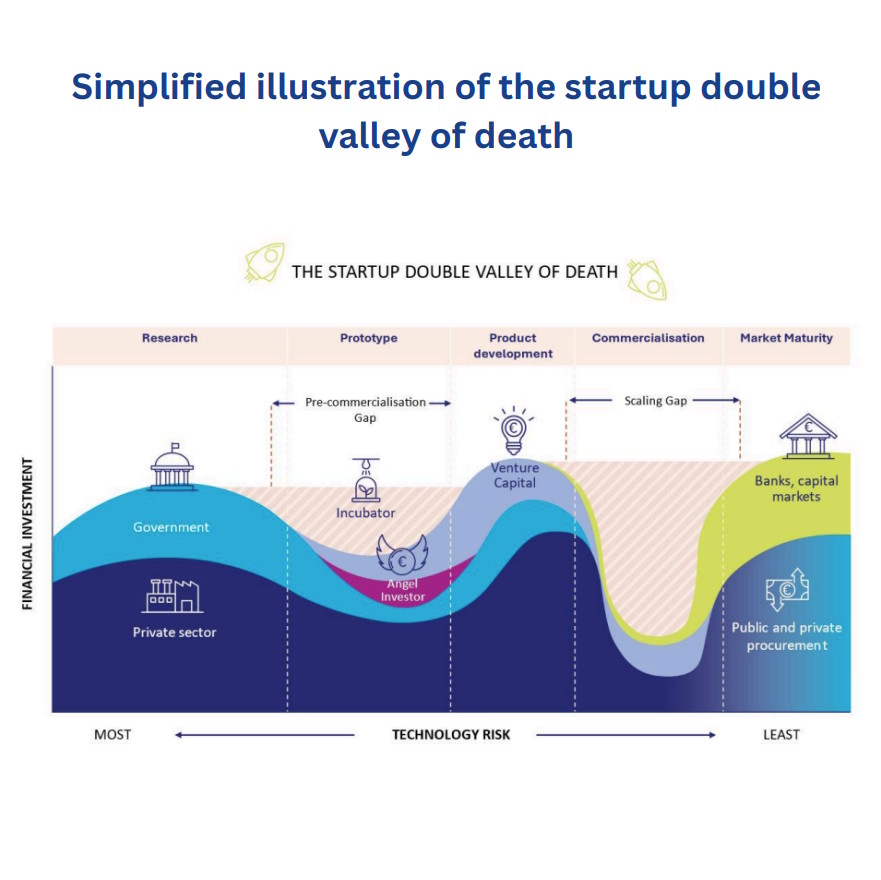
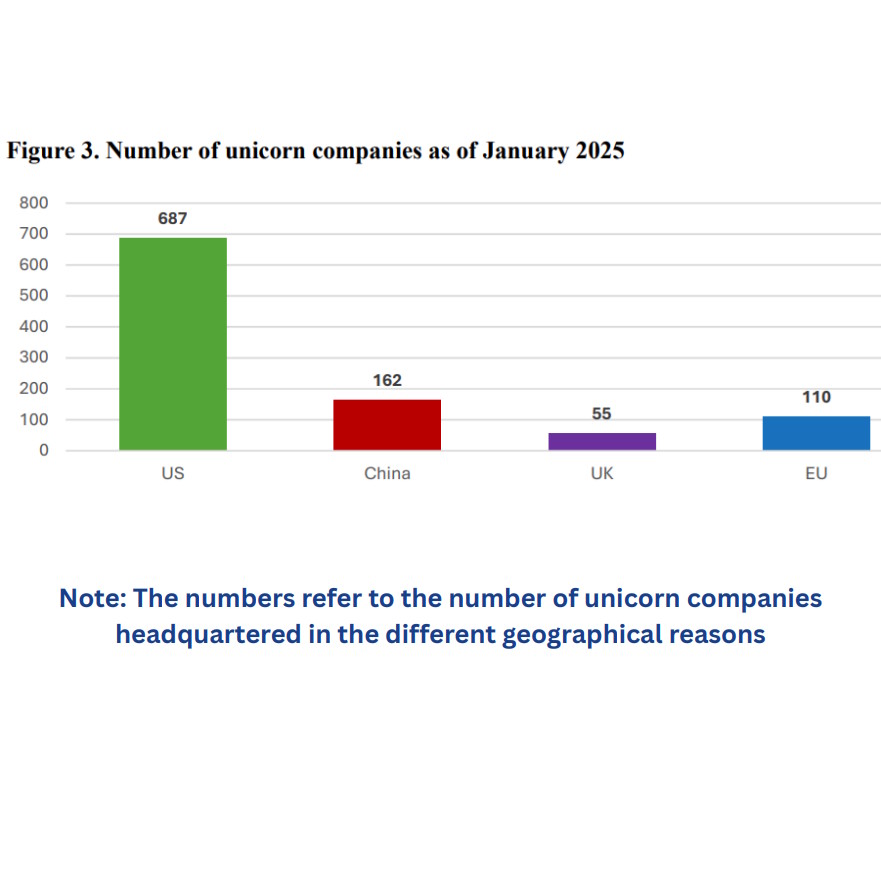
On 28 May 2025, the European Commission has launched the EU Startup and Scaleup Strategy, to make Europe a great place to start and grow global technology-driven companies.

โœ… The EU Startup and Scaleup Strategy aims to make Europe the best place in the world to launch and grow global technology-driven companies, including deep tech companies. This is crucial for strategic technologies, such as for example cleantech and energy (including nuclear technology).

โ˜‘๏ธ The key needs of startups and scaleups:

๐Ÿ“Œ Fostering innovation-friendly environment:

  • Startups and scaleups need less fragmentation, fewer administrative burdens, as well as rules that are simpler and more supportive across the Single Market.
  • a European 28th regime will be proposed to simplify rules and reduce the cost of failure by addressing critical aspects in areas like insolvency, labour and tax law.
  • The European Business Wallet will enable seamless digital interactions with public administrations across the EU through a unified digital identity for all economic operators.
  • The forthcoming European Innovation Act will further support innovation by promoting regulatory sandboxes.

๐Ÿ“Œ Driving better financing:

  • The Savings and Investments Union initiative will be key to unlocking more financing and investment opportunities in the EU.
  • The Strategy aims to expand and simplify the European Innovation Council, deploy a Scaleup Europe Fund to help bridge the financing gap of deep tech scale-up companies, and develop a voluntary European Innovation Investment Pact to mobilise large institutional investors to invest in EU funds, venture capital funds and unlisted scaleups.

๐Ÿ“Œ Supporting market uptake and expansion:

  • The Strategy introduces a Lab to Unicorn initiative, which includes the European Startup and Scaleup Hubs.

๐Ÿ“Œ Attracting and retaining top talent:

  • The Strategy introduces the Blue Carpet initiative, notably focusing on entrepreneurial education, tax-related aspects of employee stock options and cross-border employment.
  • The Blue Card Directive will be promoted to put in place a fast-track schemes for non-EU founders.

๐Ÿ“Œ Facilitating access to infrastructure, networks and service:

  • The Strategy proposes to simplify and harmonise diverging access and contractual conditions for startups and scaleups to technology and research infrastructures through a Charter of Access for industrial users.

โžก๏ธ Source: Commission launches ambitious Strategy to make Europe a startup and scaleup powerhouse

Newย pieces of secondary legislationย related toย theย Net-Zero Industry Act

Net-Zero Industry Act

On 23 May 2025, the European Commission adopted new pieces of secondary legislation and a communication relating to the Net-Zero Industry Act (NZIA).

๐Ÿ“ƒ Adopted Acts:

โœ… Communication providing updated information to determine the shares of the EU supply of final products and their main specific components originating in different third countries under NZIA

  • provides information on where the EU’s supply of net-zero technologies comes from, highlighting third country dependencies for specific technologies. This information enables the application of the ‘resilience’ non-price criterion in public procurement, renewable energy auctions, and other public interventions.
  • helps Member States in evaluating net-zero technology manufacturing projects eligible for strategic project status.

โœ… Implementing Regulation specifying the pre-qualification and award criteria for auctions for the deployment of energy from renewable sources

  • These criteria include responsible business conduct, cybersecurity, and sustainability and resilience contribution.
  • Starting on 30 December 2025, the new rules must be applied to 30% of auction volumes (or 6 GW per year per EU country).

โœ… Delegated Regulation regarding the identification of sub-categories within net-zero technologies and the list of specific components used for those technologies

  • replaces Annex with list of final products and specific components in NZIA.

โœ… Implementing Regulation regarding the list of net-zero technology final products and their main specific components for the purposes of assessing the contribution to resilience

  • includes Annex with list of net-zero technology final products and their main specific components for the purposes of assessing the contribution to resilience.

โœ… Implementing Decision adopting guidelines for the implementation of certain selection criteria for net-zero strategic projects

  • ensures a consistent selection process across Member States, through guidance on the applicable criteria for that strategic project selection.

โ˜‘๏ธ What next?

๐Ÿ“Œ For the Delegated Regulation, following publication, the European Parliament and the Council have a 2-month scrutiny period (extendable by a further 2 months if requested), during which they can object to this act.

๐Ÿ“Œ However, there is no scrutiny period for the Implementing Regulations adopted on 23 May 2025.

โžก๏ธ Source: Net-Zero Industry Act secondary legislation

Results of the 2nd Hydrogen Bank Auction

Results of the 2nd Hydrogen Bank Auction

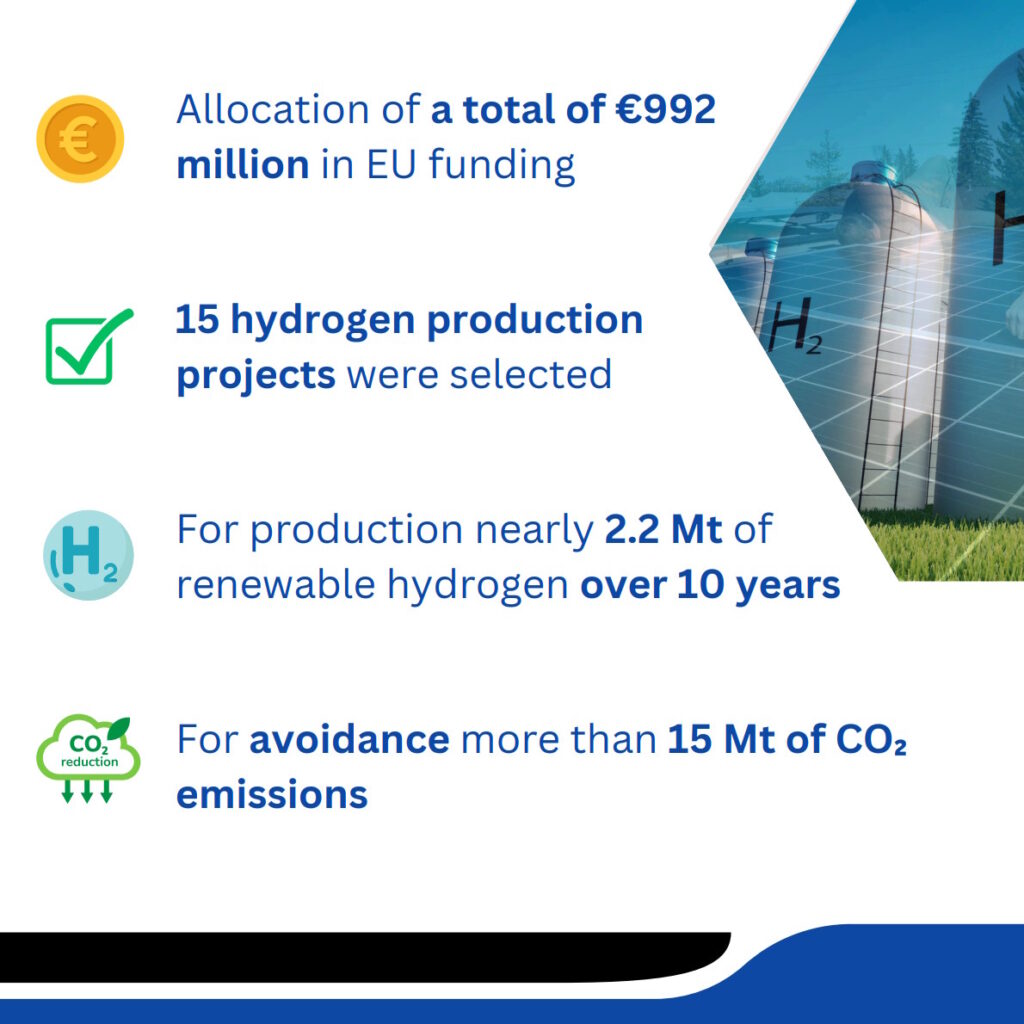
An Overview of the Results of the 2nd Hydrogen Bank Auction

๐Ÿ’ฐ Allocated Budget:

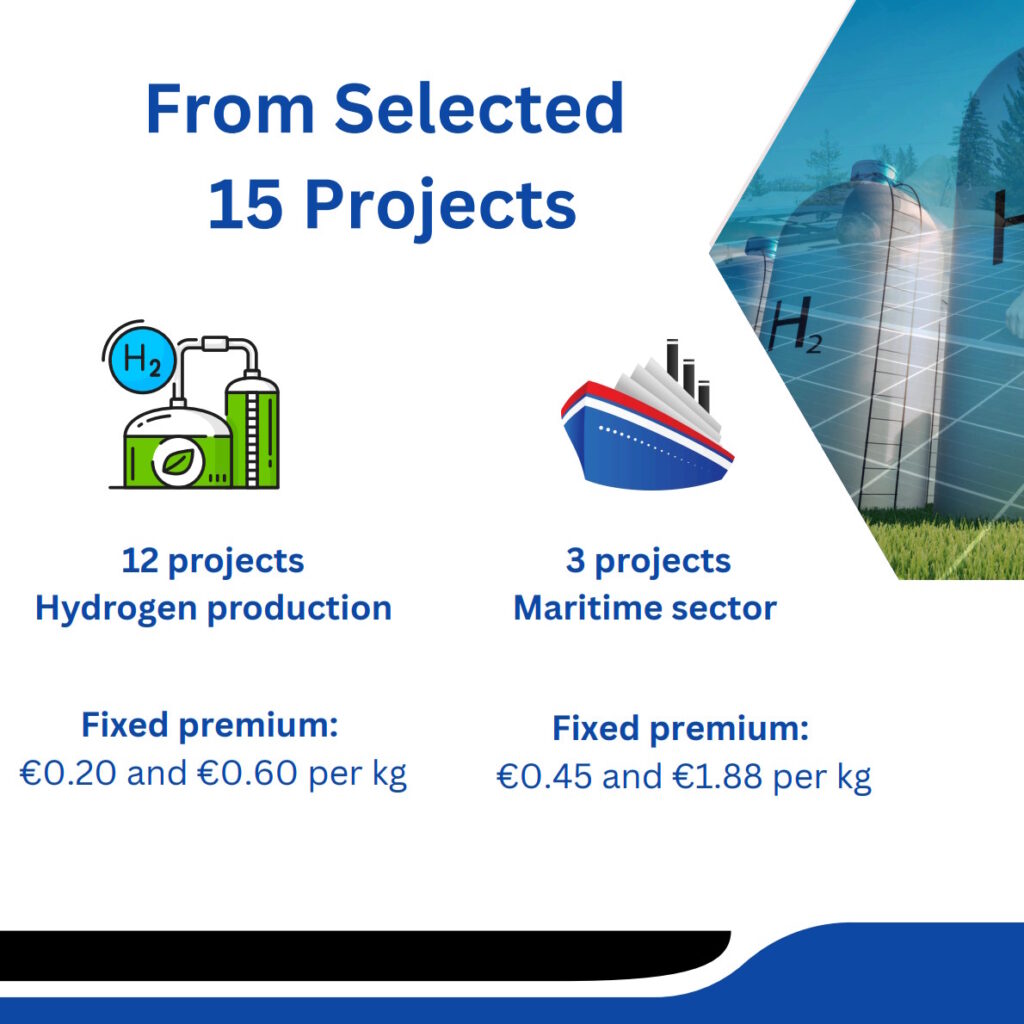
๐Ÿ“Œ EUR 895,364,238 โ€“ for 12 projects under the general topic

๐Ÿ“Œ EUR 96,677,425 โ€“ for 3 projects in the maritime sector

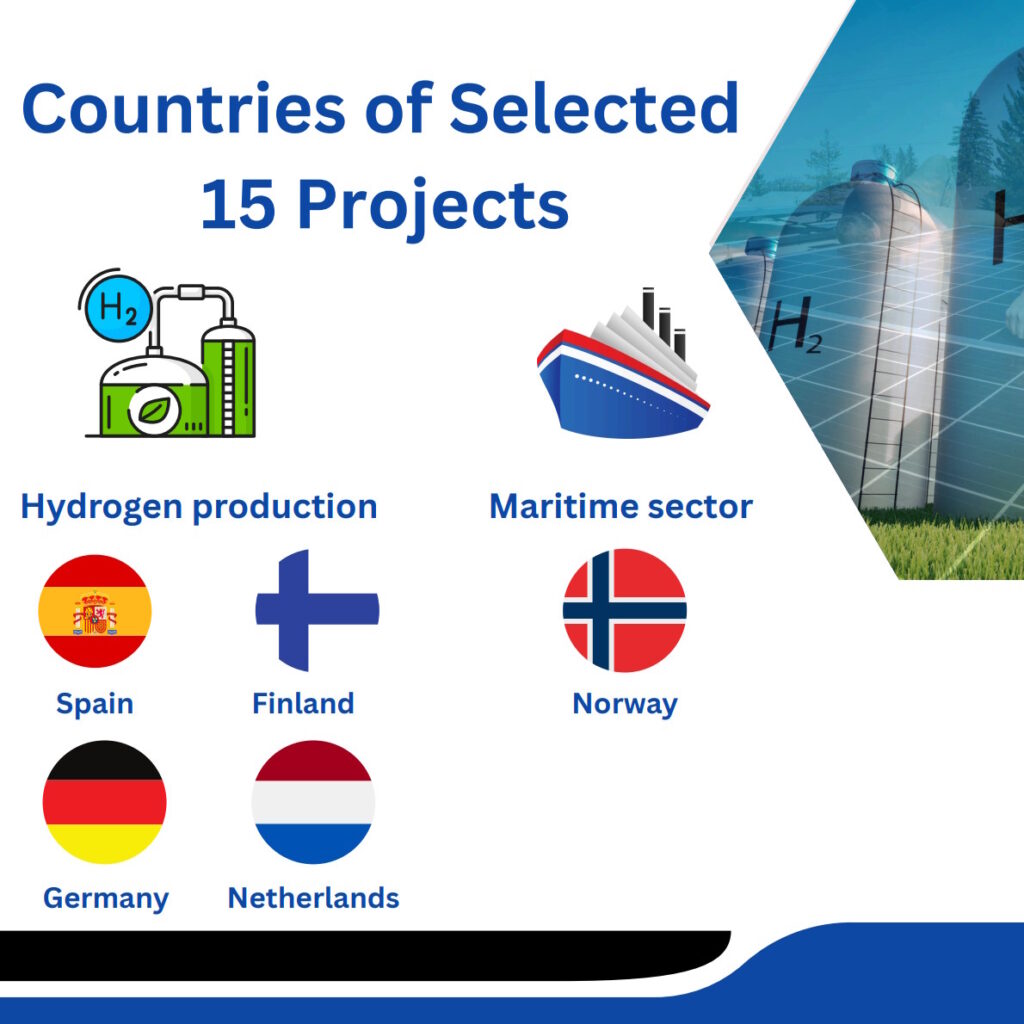
๐ŸŒ Geographical Distribution of Selected Projects:

  • 8 โ€“ Spain
  • 3 โ€“ Norway
  • 2 โ€“ Germany
  • 1 โ€“ Netherlands
  • 1 โ€“ Finland

โœ… Spain and Germany reported the highest production volumes and planned installed electrolyser capacities:

๐Ÿ“Œ Spain: 3,531,791 tons over 10 years; 3,203 MWe of aggregated electrolyser capacity

๐Ÿ“Œ Germany: 1,082,989 tons over 10 years; 1,098 MWe of aggregated electrolyser capacity

๐Ÿ“ˆ The average levelized cost of RFNBO hydrogen in the listed countries ranges from EUR 5.5 to 11.1/kg

โ˜‘๏ธ Preferred contract structure: Fixed-price agreements with off-takers

โ˜‘๏ธ Most common delivery method: Pipeline

โšก Main power source: Onshore wind energy, typically combining grid connection with a renewable PPA

โžก๏ธ Sources:
โ–ช๏ธ Press release
โ–ช๏ธ Presentation

Enforcement of the ReFuelEU Aviation Regulation by EU Member States

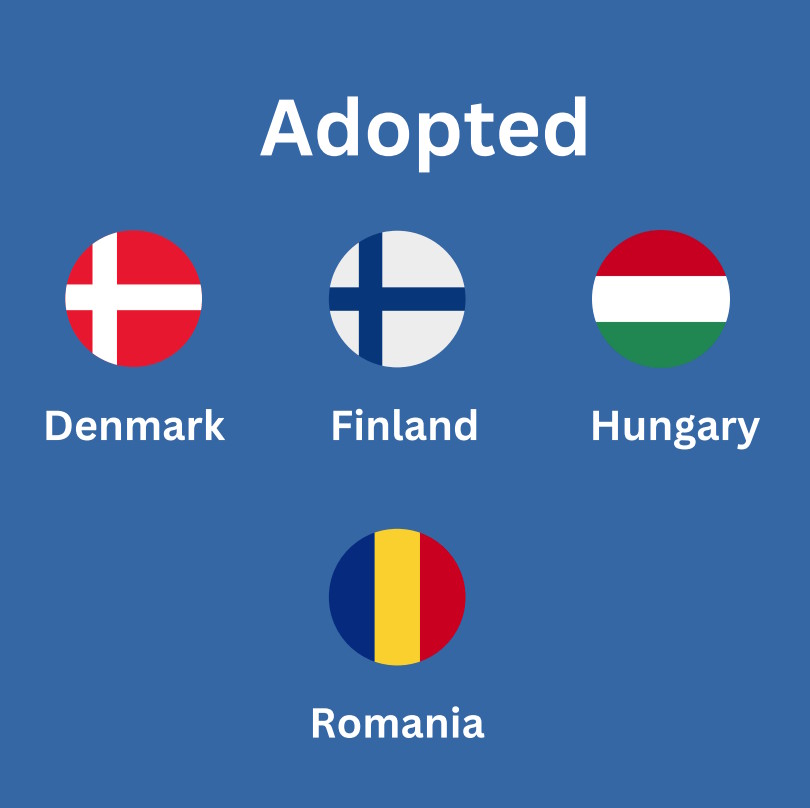
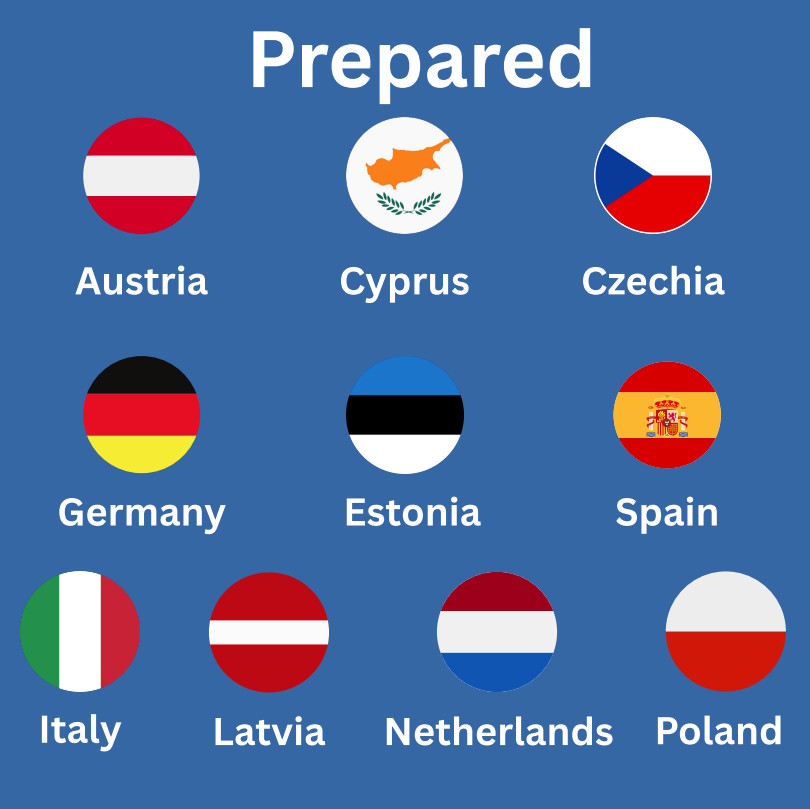
Member States enforcing the ReFuelEU Aviation Regulation

How are EU Member States enforcing the ReFuelEU Aviation Regulation?

The European Commission has published an overview of the enforcement status of the ReFuelEU Aviation Regulation across EU Member States.

โ„น๏ธ This overview was compiled based on data provided by Member States and is published for information purposes.

๐Ÿ“… Last updated: 5 May 2025.

โžก๏ธ Source: Overview_of_Member_States_enforcement_of_RFEUA

Public Consultations. Innovation Fund

public consultation to evaluate the operations of the Innovation Fund by 2025

The European Commission has started the public consultation to evaluate the operations of the Innovation Fund by 2025.

๐Ÿ“„ Form of Feedback – the online questionnaire via this link

๐Ÿ“… Feedback period – 15 April 2025 – 08 July 2025

โœ… What is the Innovation Fund?

๐Ÿ“Œ The Innovation Fund is one of the worldโ€™s largest funding programmes for the deployment of net-zero and innovative technologies.

๐Ÿ“Œ The Innovation Fund was established by the Emissions Trading System (ETS) Directive to support innovation in low or zero-carbon products, processes and technologies in the sectors covered by the Directive.

๐Ÿ“Œ The Fund obtains its resources from ETS allowance revenues.

โžก๏ธ Source: What is the Innovation Fund?

โ˜‘๏ธ Purpose and Scope of Evaluation:

๐Ÿ“Œ The European Commission will:

  • evaluate the implementation of the Innovation Fund from 2020 to 2024.
  • will focus primarily on assessing synergies between the Fund and other EU programmes, including Horizon Europe, and the procedures for disbursing financial support.

๐Ÿ“Œ The evaluation will assess:

  • Effectiveness: the degree to which the Fund has succeeded in achieving its objectives of:
    1. supporting projects that demonstrate highly innovative technologies, processes and products;
    2. providing financial support tailored to market needs and risk profiles of eligible projects while attracting additional public and private resources;
    3. ensuring that Innovation Fund revenues are managed to accomplish the objectives of the ETS Directive.
  • Efficiency: how ETS allowances have been employed to achieve the expected effects of the Fund, alongside the administrative burden associated with application, evaluation, and project implementation.
  • Relevance: the connection between the Fundโ€™s objectives and the attainment of EU climate targets, particularly emissions reduction and necessary technology development, while strengthening competitiveness and resilience.
  • Coherence: how the various elements of the Fund function cohesively to achieve its objectives and how they synergise with the EUโ€™s policy objectives and other programmes, such as Horizon Europe, the Recovery and Resilience Fund, and InvestEU.
  • EU added value: the extent to which the results and impacts of the Fund contribute to changes prompted by the Commissionโ€™s intervention over what could reasonably have been expected from national actions.

โžก๏ธ Source: Industrial Decarbonisation Accelerator Act – speeding up decarbonisation