World Energy Outlook 2025

International Energy Agency. World Energy Outlook 2025

☑️ The World Energy Outlook 2025 (WEO-2025) of International Energy Agency considers the following scenarios:

📌 Current Policies Scenario (CPS): A snapshot of policies and regulations that are already in place.

📌 Stated Policies Scenario (STEPS): Encompasses a broader range of policies, including those that have been formally proposed but not yet adopted, as well as other official strategy documents that indicate the intended direction of policy.

📌 Net Zero Emissions by 2050 Scenario (NZE Scenario): Describes a pathway to reduce global energy-related CO₂ emissions to net zero by 2050, while recognising that each country will follow its own route.

☑️ Key Takeaways

📌 Electricity

  • Electricity demand grows much faster than overall energy use in all scenarios: it rises by around 40% to 2035 in both the CPS and the STEPS, and by more than 50% in the NZE Scenario.
  • Electricity currently accounts for only 21% of total final energy consumption globally, yet it is the key energy source for sectors representing over 40% of the global economy, and the main energy source for most households.
  • A pivotal issue for electricity security is the pace at which new grids, storage facilities, and other sources of power system flexibility are developed.
  • Investments in electricity generation have surged by almost 70% since 2015, reaching USD 1 trillion per year, while annual grid spending has increased at less than half that pace to around USD 400 billion.
  • The explosive growth in electricity demand for data centres and AI is concentrated in advanced economies and China. Investment in data centres is expected to reach USD 580 billion in 2025. A tripling of electricity consumption by data centres by 2035 will represent less than 10% of total global electricity demand growth, but it will be highly concentrated geographically. More than 85% of new data centre capacity additions over the next ten years are expected in the United States, China, and the European Union.

📌 Renewables

  • Renewables grow faster than any other major energy source in all scenarios, led by solar photovoltaics.

📌 Nuclear Power

  • Another common element across scenarios is the revival of nuclear energy, with investment rising in both traditional large-scale plants and new designs, including small modular reactors (SMRs).
  • More than 40 countries now include nuclear energy in their strategies and are taking steps to develop new projects.

➡️ Source: International Energy Agency. World Energy Outlook 2025
IEA Global Hydrogen Review 2025

International Energy Agency Global Hydrogen Review 2025

The hydrogen sector is growing despite persistent barriers and project delays.

✅ Key Takeaways from the IEA Global Hydrogen Review 2025:

1️⃣ Global demand continues to rise

  • Hydrogen demand reached 100 Mt in 2024, up 2% from 2023.
  • Fossil fuels still dominate supply: 290 bcm natural gas and 90 Mtce coal equivalent.
  • Low-emissions hydrogen grew 10% in 2024, but remains <1% of total production.

2️⃣ Project delays and cancellations

  • Uptake of low-emissions hydrogen lags behind ambitions due to high costs, regulatory uncertainty, and slow infrastructure development.
  • The sector shows signs of maturity: 200+ low-emissions projects received FIDs since 2020, up from just a few demonstration projects.
  • Innovation across the value chain is strong.

3️⃣ Production outlook to 2030

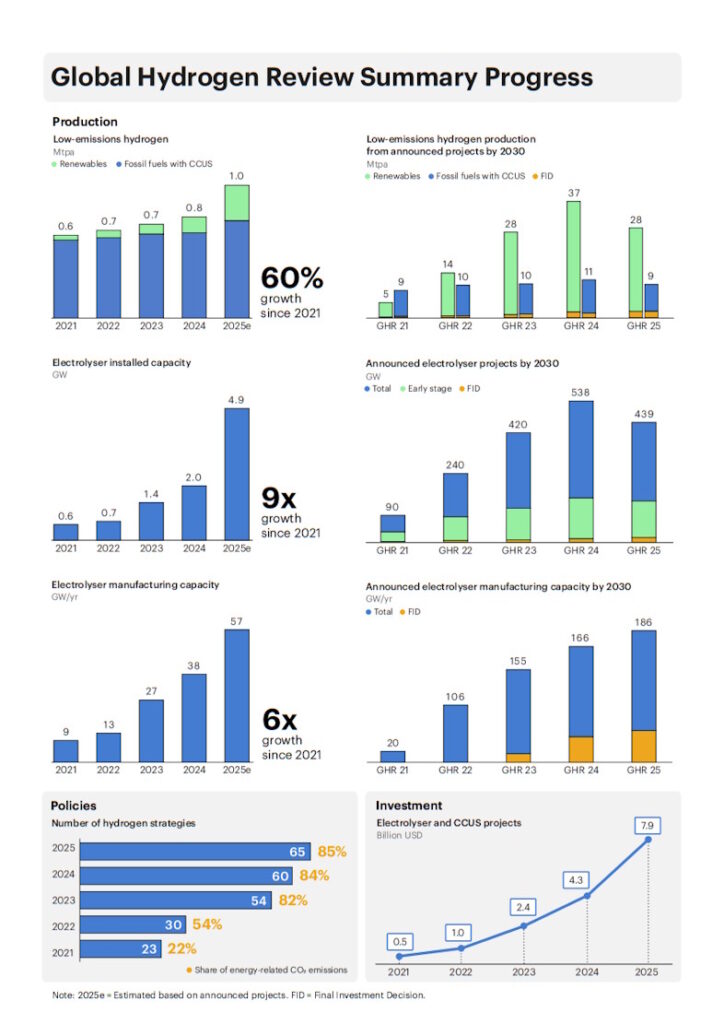
  • Announced low-emissions projects have decreased from 49 Mtpa to 37 Mtpa due to delays and cancellations, mainly in electrolysis.
  • However, operational projects and projects reached FIDs could deliver 4.2 Mtpa by 2030, a fivefold increase from 2024.
  • An additional 6 Mtpa could come online by 2030 if effective policies and offtake mechanisms are implemented.

4️⃣ Costs and competitiveness

  • The cost gap between low-emissions hydrogen and fossil-based production remains a challenge, though expected to narrow by 2030.
  • China and Europe could see cost-competitive renewable hydrogen.
  • In the US and Middle East, CCUS for producing low-emissions hydrogen may remain more competitive in the near term.

5️⃣ Policy and demand signals

  • Momentum for hydrogen offtake agreements slowed in 2024: 1.7 Mtpa signed vs. 2.4 Mtpa in 2023.
  • Most agreements remain in refining, chemicals, shipping, and some aviation.
  • Policies to create demand are progressing but full impact will depend on implementation.
Global Hydrogen Review Summary Progress: Production, Electrolyser installed capacity, Announced electrolyser projects by 2030, Electrolyser manufacturing capacity, Announced electrolyser manufacturing capacity by 2030, Policies and Investment

Figure: Global Hydrogen Review Summary Progress

➡️ Source: Global Hydrogen Review 2025

Annual Energy Outlook 2025

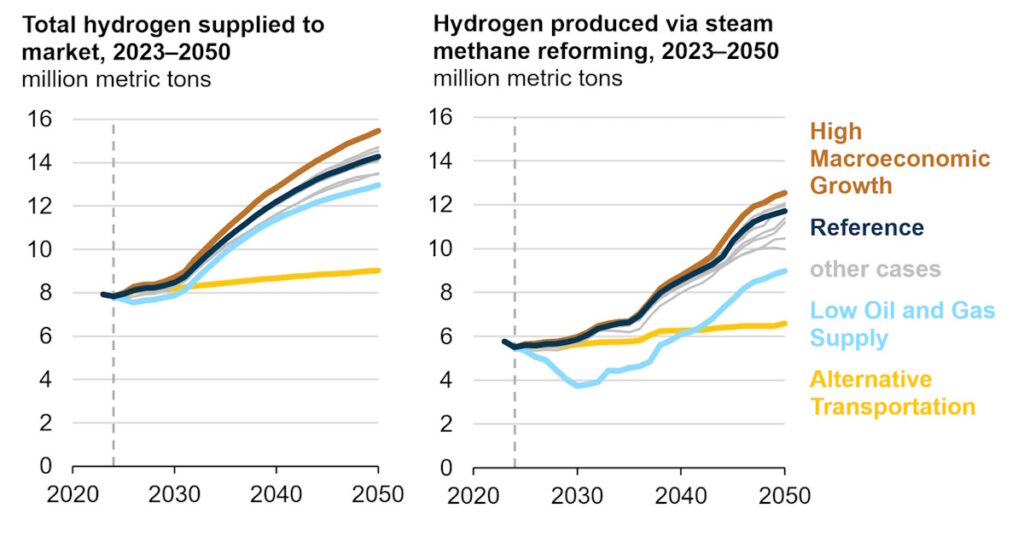
Long-term projections: total hydrogen supplied to market, 2023-2050, hydrogen produced via steam methane reforming, 2023-2050

Figure: Long-term projections for supply and production of hydrogen

Source: Annual Energy Outlook 2025

According to the latest Annual Energy Outlook 2025 by the U.S. Energy Information Administration, even when accounting for the IRA incentives prior to the “One Big Beautiful Bill Act”, hydrogen produced from natural gas remains dominated in the long-term outlook.

📊 By 2050, the majority of H2 in the U.S. is projected to be produced from natural gas via steam methane reforming (SMR). Less than 1% is expected to come from electrolyzers, despite supportive policies.

➡️ Full analysis: Natural gas remains the largest source of hydrogen in our long-term projections

Yet, this contrasts with the vision laid out in the U.S. National Clean Hydrogen Strategy and Roadmap, which foresees a more diverse production mix — including electrolysis, fossil-based hydrogen with CCS, and biomass/waste-derived hydrogen, playing key roles through at least 2050.

The key takeaway: Ambition and reality are still not fully aligned, when it comes to scaling up green hydrogen.

➡️ Source: U.S. National Clean Hydrogen Strategy and Roadmap

Bringing Hydrogen to the EU Market

In this episode of Clean Energy Talks video blog with Joris Vlasblom, an experienced energy advisor specializing in hydrogen, renewable energy, and Sustainable Aviation Fuel (SAF), we talk about bringing hydrogen to the EU Market:

I. EU Hydrogen Targets & Demand

How do you assess the current demand for hydrogen and its derivatives in the EU?

How aligned is the current market demand with the EU’s hydrogen targets for 2030 and beyond?

II. Market Entry & Readiness

What are the biggest challenges to bringing hydrogen into the EU market today?

III. Certifications & Standards

How can producers confirm the compliance of hydrogen with EU market requirements?

How crucial is the RFNBO certification for accessing the EU market?

IV. Infrastructure & Technology

What infrastructure gaps (e.g. ports, pipelines, storage) are most urgent to address?

V. Practical Solutions

What are some practical steps companies should take when planning to enter the EU hydrogen market?

➡️ Reach out here on LinkedIn or contact me for more details on the video topic.