Preparatory process for the 2026 bidding round of Carbon Contracts for Difference

Preparatory process for the 2026 bidding round of Carbon Contracts for Difference (Klimaschutzverträge)
📢 Germany launches preparatory process for the 2026 bidding round of Carbon Contracts for Difference (Klimaschutzverträge)

On 6 October, the German Federal Ministry for Economic Affairs and Climate Action (BMWK) initiated the preparatory phase for the 2026 bidding round of CO2-Differenzverträge (Carbon Contracts for Difference, CCfDs). Carbon Contracts for Difference are one of the key funding instruments supporting the decarbonisation of energy-intensive industries.

✅ Main purposes of the CCfDs:

📌 CCfDs protect companies investing in low-carbon production processes against price risks. Fluctuations in CO2 and energy prices, as well as cost differences compared to conventional production processes, are compensated over a period of 15 years.

📌 The contracts also aim to accelerate the market ramp-up of new technologies (e.g. industrial heat pumps, hydrogen applications, CO2 capture and storage, and energy storage technologies) and to help establish innovative production processes on the market.

☑️ Eligibility requirements:

📌 Companies are free to decide how to convert their production processes in line with the energy sources used (electricity, low-carbon hydrogen, biomass).

📌 The only requirements are milestones for CO2 savings: 60% from the third year and 90% in the final year of the contract term.

📌 Companies are remunerated based on the actual CO2 savings achieved.

📌 The CCfDs are also open to small and medium-sized enterprises with smaller production facilities.

📅 Schedule:

  • Participation in the preparatory phase until 1 December 2025 is required for companies wishing to submit bids in 2026.

⚠️ The bidding process remains subject to budgetary approval and state aid clearance by the European Commission.

📘 More information and documentation on the preparatory process are available at https://www.klimaschutzvertraege.info/
➡️ Source: BMWE startet vorbereitendes Verfahren für das Gebotsverfahren 2026 der CO2-Differenzverträge (Klimaschutzverträge)

Defossilizing Industry: Considerations for Scaling-up Carbon Capture and Utilization Pathways

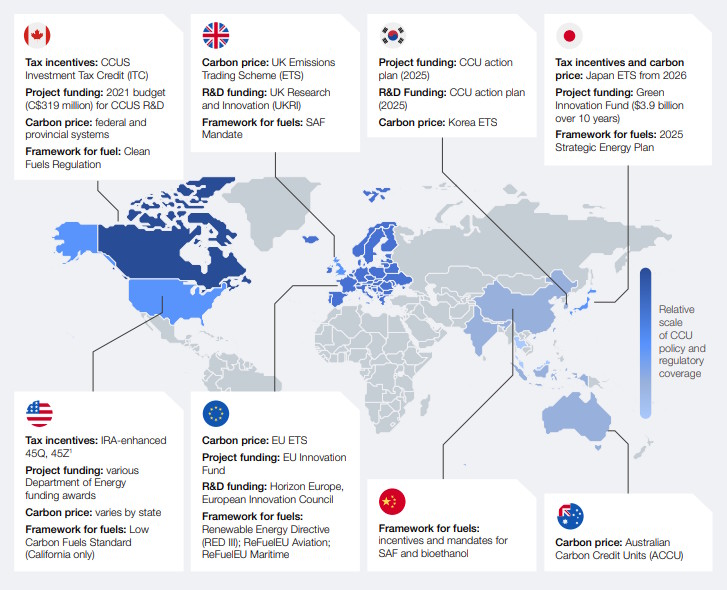
Global distribution of CCU-relevant policy frameworks

Figure: Global distribution of CCU-relevant policy frameworks

Source: Wood Mackenzie Lens Carbon

The World Economic Forum has just published its white paper: “Defossilizing Industry: Considerations for Scaling-up Carbon Capture and Utilization Pathways”.

✅ The report highlights key challenges for Carbon Capture and Utilization (CCU) policy framework:

📌 The global CCU policy landscape remains fragmented, inconsistent, and often conflicting.

📌 Sequestration is prioritized over reuse, while the lack of an effective global carbon price undermines wider deployment of capture technologies.

📌 These gaps create uncertainty for innovators and reduce policy credibility for investors.

📌 Current frameworks are regionally specific, leading to concentrated initiatives in certain jurisdictions and heightening risks from policy instability.

📌 Scaling CCU requires a more coordinated, credible, and globally consistent policy environment to unlock its full potential for industrial decarbonization.

➡️ Source: World Economic Forum. Defossilizing Industry: Considerations for Scaling-up Carbon Capture and Utilization Pathways. White Paper. September 2025

Briefing Delegated act on low-carbon hydrogen

European Parliamentary Research Service. Briefing: Delegated act on low-carbon hydrogen

I dove into the European Parliamentary Research Service Briefing on the “Delegated Act on Low-carbon Hydrogen”.

✅ Key takeaways:

📌 The delegated act, adopted by the Commission on 8 July 2025, is the final missing piece of the EU’s hydrogen regulatory framework. Its was adopted by the Commission on 8 July 2025, pending scrutiny by the Parliament and the Council until 10 November.

📌 The delegated act does not create financial incentives or targets but provides much-needed regulatory clarity on what qualifies as low-carbon hydrogen, supporting cross-border trade, investment, and a future EU hydrogen market.

📌 Electrolysis via the grid is only eligible in countries with very low grid emissions (currently: France, Sweden, Finland). Elsewhere, PPAs will play a key role.

📌 Nuclear power: The delegated act does not include a specific methodology for producing low-carbon hydrogen from nuclear power plants. The Commission plans to launch a public consultation on a draft methodology for this production method in 2026.

📌 Blue hydrogen faces stricter requirements. LNG-related emissions must be calculated using a methane-intensity methodology by 2027/28, raising uncertainty.

📌 Production costs: CCS-based hydrogen remains cheaper in the near term, while electrolytic hydrogen is still challenged by high EU power prices.

📌 Imports: The same low-carbon criteria apply to non-EU producers; a region-specific GHG methodology could follow by 2028.

⚠️ Parliament had already stressed in 2021 that low-carbon hydrogen must be seen as a bridging technology in the short and medium term, but also called for a clear distinction from renewable hydrogen.

The upcoming months will show whether Parliament and Council accept this final building block of EU hydrogen regulation or send the Commission back to the drawing board.

➡️ Source: European Parliamentary Research Service. Briefing: Delegated act on low-carbon hydrogen

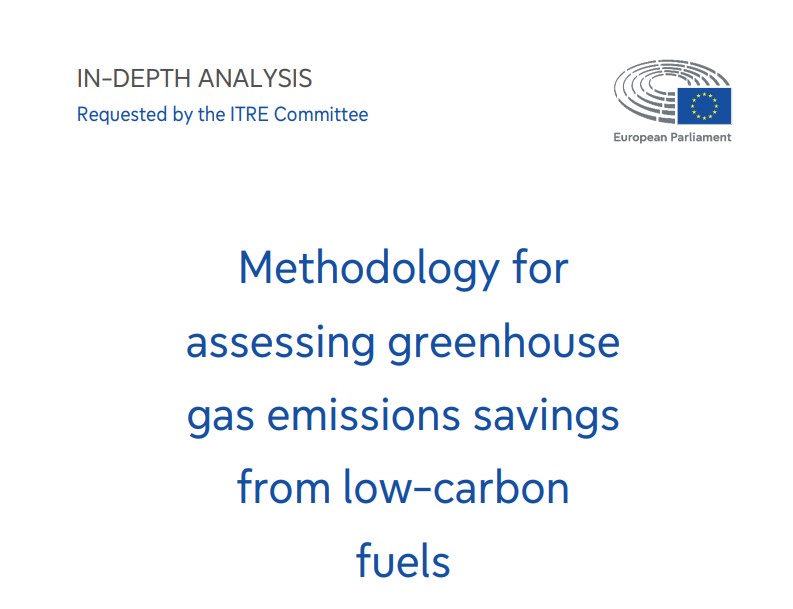
Methodology for assessing greenhouse gas emissions savings from low-carbon fuels

Report "Methodology for assessing greenhouse gas emissions savings from low-carbon fuels"

This report, prepared at the request of the European Parliament’s Committee on Industry, Research
and Energy (ITRE) reviews the draft Delegated Act (DA) on low-carbon fuels and addresses following questions:

🔹 Which production pathways are included?

  • The DA applies a technology-neutral, life-cycle approach.
  • Fuels must achieve at least a 70% reduction vs. the fossil comparator (94 gCO₂eq/MJ).
  • Both fossil pathways with CCS and electrolytic production routes for hydrogen production are eligible.
  • Nuclear-based electricity is also recognised.
  • Hydrogen leakage will be included once scientific consensus exists on its warming impact.

🔹 Does the DA enable the hydrogen economy?

  • The Delegated Act (DA) is a regulatory enabler, not a market driver.
  • The DA creates regulatory certainty via harmonised EU-wide accounting and certification, reducing investment risk and avoiding fragmented national rules.
  • The DA is not a demand-side driver, no targets or incentives are included.

🔹 Does the DA address fossil fuel emissions?

  • The DA incorporates methane CH₄ and CO₂ defaults but they are not strongly conservative.
  • LNG-specific values are missing, risking underestimation. Its effectiveness will hinge on strict enforcement and robust methane reporting.

🔹 Price & cost expectations

  • Blue H₂: 3.5–6.5 €/kg (costs depend on gas prices, CCS costs, and volatility).
  • Electrolytic H₂: 6–8 €/kg today; costs could fall <3 €/kg with cheaper electrolysers + low-carbon electricity.

➡️ Overall: The DA is an important regulatory enabler. It sets the rules for certification and trade but does not itself stimulate hydrogen demand.

➡️ Source: Report: Methodology for assessing greenhouse gas emissions savings from low-carbon fuels

Pacific Northwest Low-Carbon Hydrogen Analysis

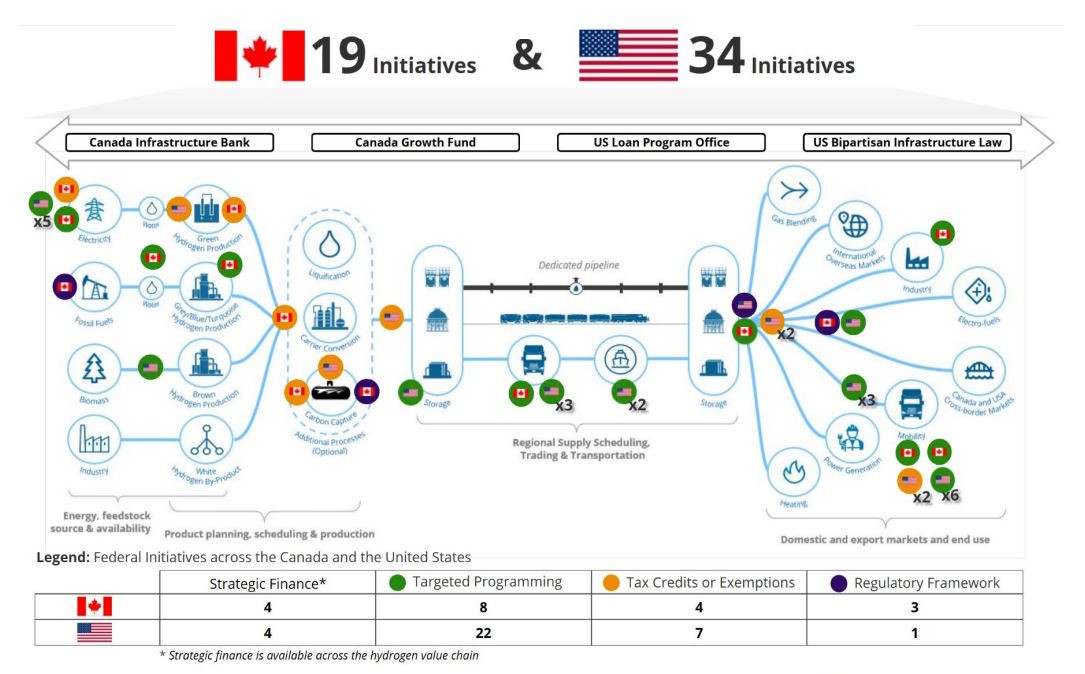
Low-Carbon Hydrogen Analysis. Federal Initiatives across the Canada and the United States. Canada and United States support initiatives and value chain applicability

Figure: Canada and United States support initiatives and value chain applicability

Source: New report: Pacific Northwest Low-Carbon Hydrogen Analysis

Pacific Northwest Low-Carbon Hydrogen Analysis, published by The Pacific Northwest Economic Region (PNWER), provides a comprehensive view of supply, demand and trade opportunities for low-carbon hydrogen between the US and Canada.

✅ Some takeaways

📌 Canada:

  • has a total of 19 direct or indirect support programs available to accelerate the development and deployment of hydrogen technologies and industry across the value chain.
  • Tax measures such as the Clean Hydrogen Investment Tax Credit (ITC), Clean Technology ITC, Clean Technology Manufacturing ITC, and the Carbon Capture, Utilization and Storage (CCUS) ITC are complemented by funding programs such as the Clean Fuels Fund and Strategic Innovation Fund – Net-Zero Accelerator.

📌 The US:

  • has a total of 34 direct or indirect federal programs and initiatives across multiple national departments and agencies, which enable the use of hydrogen across the value chain.
  • The US Renewable Fuel Standard (RFS) mandates the blending of renewable fuels into the supply of transportation fuels, with an aim at reducing overall GHG emissions from the sector. While the RFS primarily focuses on biofuels, it also includes provisions for hydrogen derived from renewable feedstocks, like biomass, which generates an economic incentive for the transportation sector to include low-carbon hydrogen in its pathways to decarbonization.

➡️ Source: New report: Pacific Northwest Low-Carbon Hydrogen Analysis

Regulatory Update: Low-Carbon Hydrogen Rules

In Search of the Real Price of Blue Hydrogen

Source: In Search of the Real Price of Blue Hydrogen

📢 Regulatory Update: Low-Carbon Hydrogen Rules

The European Commission plans to finalize the Delegated Act for low carbon hydrogen in the coming months, with implementation planned before the end of the year.

At the same time, growing concerns remain about the viability blue hydrogen. This is confirmed in the recent report by the Green Hydrogen Organization: “In Search of the Real Price of Blue Hydrogen”, available via this link.

✅ Key Takeaways from the report:

📌 Low-carbon hydrogen – not proven at scale

  • No current projects meet the emissions criteria of the EU, US, UK, Japan, or Korea.
  • True low-carbon production would require 95%+ carbon capture and permanent, verifiable CO₂ storage

📌 Carbon capture performance is inconsistent

  • Among 16 reviewed CCS projects, none have consistently captured more than 80% of CO₂ emissions.

📌 High uncertainty = risky pricing assumptions

  • Unlike green hydrogen projects, carbon capture assumptions are not validated by real-world performance.
  • Volatile gas prices and gaps in life-cycle emissions reporting make pricing blue hydrogen highly speculative.

☑️ CONCLUSION: clarity, predictability, and consistency in definitions and requirements will be essential to build trust and attract investment in low-carbon hydrogen pathways.

➡️ Source: Commission’s draft rules make low-carbon hydrogen ‘practically impossible’, say stakeholders