IEA Global Hydrogen Review 2025

International Energy Agency Global Hydrogen Review 2025

The hydrogen sector is growing despite persistent barriers and project delays.

✅ Key Takeaways from the IEA Global Hydrogen Review 2025:

1️⃣ Global demand continues to rise

  • Hydrogen demand reached 100 Mt in 2024, up 2% from 2023.
  • Fossil fuels still dominate supply: 290 bcm natural gas and 90 Mtce coal equivalent.
  • Low-emissions hydrogen grew 10% in 2024, but remains <1% of total production.

2️⃣ Project delays and cancellations

  • Uptake of low-emissions hydrogen lags behind ambitions due to high costs, regulatory uncertainty, and slow infrastructure development.
  • The sector shows signs of maturity: 200+ low-emissions projects received FIDs since 2020, up from just a few demonstration projects.
  • Innovation across the value chain is strong.

3️⃣ Production outlook to 2030

  • Announced low-emissions projects have decreased from 49 Mtpa to 37 Mtpa due to delays and cancellations, mainly in electrolysis.
  • However, operational projects and projects reached FIDs could deliver 4.2 Mtpa by 2030, a fivefold increase from 2024.
  • An additional 6 Mtpa could come online by 2030 if effective policies and offtake mechanisms are implemented.

4️⃣ Costs and competitiveness

  • The cost gap between low-emissions hydrogen and fossil-based production remains a challenge, though expected to narrow by 2030.
  • China and Europe could see cost-competitive renewable hydrogen.
  • In the US and Middle East, CCUS for producing low-emissions hydrogen may remain more competitive in the near term.

5️⃣ Policy and demand signals

  • Momentum for hydrogen offtake agreements slowed in 2024: 1.7 Mtpa signed vs. 2.4 Mtpa in 2023.
  • Most agreements remain in refining, chemicals, shipping, and some aviation.
  • Policies to create demand are progressing but full impact will depend on implementation.
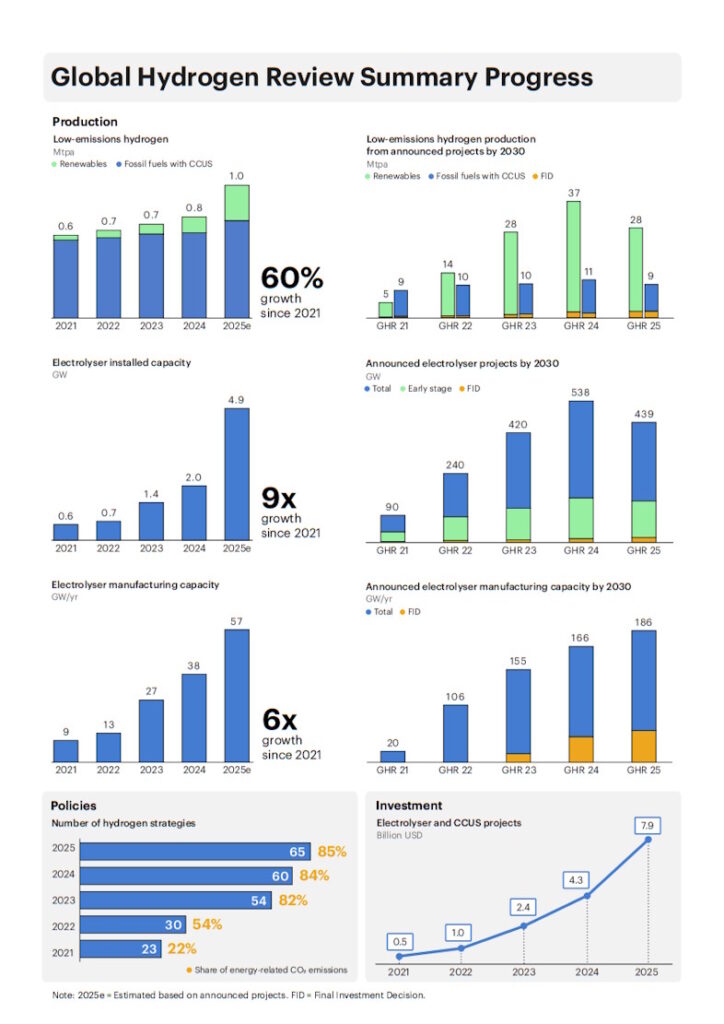
Global Hydrogen Review Summary Progress: Production, Electrolyser installed capacity, Announced electrolyser projects by 2030, Electrolyser manufacturing capacity, Announced electrolyser manufacturing capacity by 2030, Policies and Investment

Figure: Global Hydrogen Review Summary Progress

➡️ Source: Global Hydrogen Review 2025
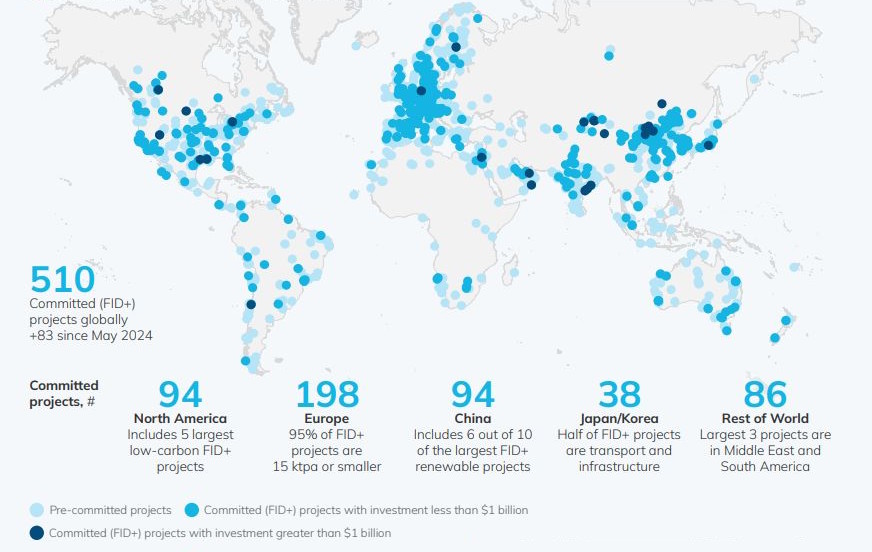
Global clean hydrogen projects

Global clean hydrogen projects by project status

Figure: Global clean hydrogen projects by project status

Source: Hydrogen Council & McKinsey Project & Investment Tracker, as of December 2020, May 2022, May 2024 and July 2025

The global hydrogen sector is evolving, and this image from the Global Hydrogen Compass 2025, published by Hydrogen Council, illustrates the current landscape.

✅ Key Takeaways:

📌 The clean hydrogen project pipeline now includes 1,749 projects, of which 510 are committed —meaning they have taken FID, started construction, or begun operation. Over 80 projects were added in the past year.

📌 The overall hydrogen project pipeline has grown 7.5 times since 2020, with 214 net new projects added since May 2024, despite a slowdown in announcements.

📌 Europe leads in the number of projects with commercial operation dates (CODs) by 2030, followed by North America and China.

📌 Around 70% of committed projects are renewable, with just under half located in Europe.

📌 While Europe focuses on developing infrastructure and demand centers for an import-oriented hydrogen industry, China’s renewable projects are on average 10 times larger.

📌 A higher share of Chinese projects (50%) are already FID+ compared to Europe (30%) and North America (35%). Early-stage projects in China may be undercounted due to lower public visibility.

➡️ Source: Global Hydrogen Compass 2025, Hydrogen Council

Potential for hydrogen trade

Potential for hydrogen trade

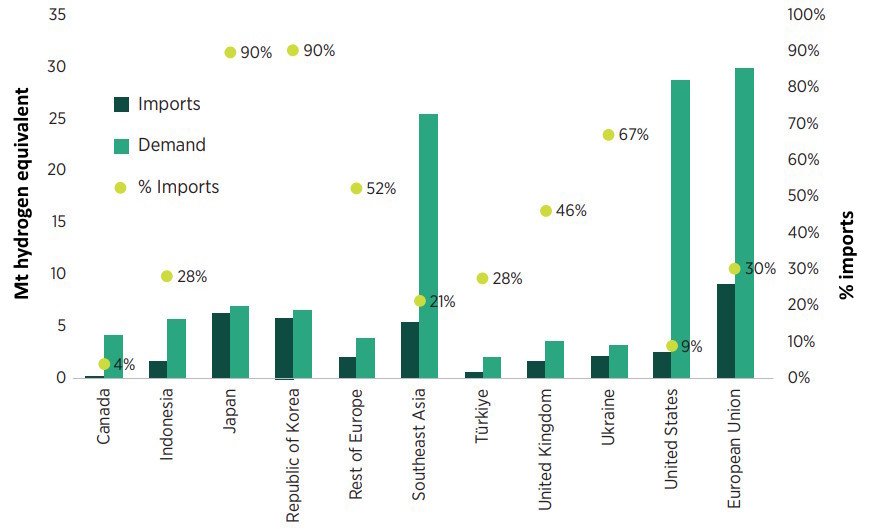
Figure: Percentage of demand for hydrogen and related commodities met by imports

Source: The potential for green hydrogen and related commodities trade

🌍 Around 20% of global hydrogen demand is expected to be met through international trade – with the remaining 80% produced locally, according to the International Renewable Energy Agency.

✅ But the picture varies significantly across regions:

  • Japan & South Korea may import up to 90% of their green hydrogen needs.
  • EU expects imports to cover around 30%.
  • Canada foresees only about 4% reliance on imports.

These differences underline the importance of tailored policies and strategies to match each country’s energy landscape.

➡️ Source: IRENA (2025), Analysis of the potential for green hydrogen and related commodities trade, International Renewable Energy Agency, Abu Dhabi.

Bringing Hydrogen to the EU Market

In this episode of Clean Energy Talks video blog with Joris Vlasblom, an experienced energy advisor specializing in hydrogen, renewable energy, and Sustainable Aviation Fuel (SAF), we talk about bringing hydrogen to the EU Market:

I. EU Hydrogen Targets & Demand

How do you assess the current demand for hydrogen and its derivatives in the EU?

How aligned is the current market demand with the EU’s hydrogen targets for 2030 and beyond?

II. Market Entry & Readiness

What are the biggest challenges to bringing hydrogen into the EU market today?

III. Certifications & Standards

How can producers confirm the compliance of hydrogen with EU market requirements?

How crucial is the RFNBO certification for accessing the EU market?

IV. Infrastructure & Technology

What infrastructure gaps (e.g. ports, pipelines, storage) are most urgent to address?

V. Practical Solutions

What are some practical steps companies should take when planning to enter the EU hydrogen market?

➡️ Reach out here on LinkedIn or contact me for more details on the video topic.

The Impact of Renewable Hydrogen on the Power System

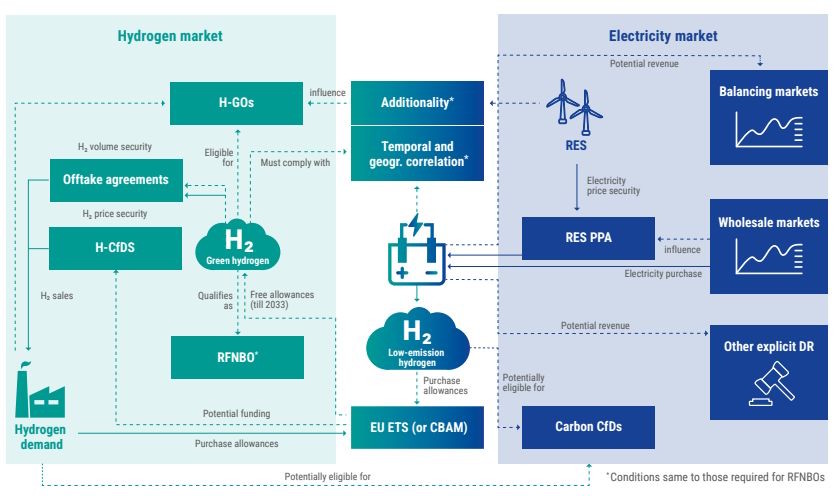
electrolyser at the intersection of the hydrogen and electricity markets, the associated revenue streams, and possible support mechanisms

Figure: Electrolyser at the intersection of the hydrogen and electricity markets, the associated revenue streams, and possible support mechanisms

Source: Market Design and Regulatory Framework for Viable and Flexible Hydrogen Production Report, June 2025

New ENTSO-E Report: The Impact of Renewable Hydrogen on the Power System

This comprehensive report offers valuable insights into the growing hydrogen market and its interdependence with the electricity system.

✅ Key Takeaways:

📌 System Integration is Key

Electrolysers and hydrogen facilities should be strategically planned, located, and operated in coordination with the power system to maximise system benefits and consumer value.

📌 Location Matters

Whether near renewable energy sources, hydrogen demand centers, or both — the siting and grid connection (on-grid/off-grid) of electrolysers are crucial for infrastructure optimisation, especially as natural gas is phased out.

📌 Smart Regulation & Market Design

Policies defining renewable hydrogen must consider not just the hydrogen sector, but also incentivise investments that support the power system and accelerate decarbonisation.

📌 Flexibility Potential

Electrolysers could provide valuable short-duration flexibility via implicit and explicit demand response, especially as the market matures.

📌 Contributing to Resource Adequacy

Power-to-Hydrogen (P2H2) supports the grid through demand response. Hydrogen-to-Power (H2P) can offer carbon-neutral backup via repurposed gas turbines and capacity mechanisms.

📌 Certification Trade-offs

Hydrogen regulation (e.g., GOs and RFNBO criteria) must find a balance between strict decarbonisation goals and power system needs. To strike a balance, GOs and RFNBO requirements should be designed with flexibility in mind.

➡️ Source: Report on Impact of Renewable Hydrogen on the Power System

Hydrogen Offtake Security

In this episode of Clean Energy Talks video blog with Khrystyna Kasyanova, a Green Hydrogen Business Development Manager at RP Global, we talk about hydrogen offtake agreements in the EU and globally:

  • What is the current state of the hydrogen sector?
  • What actions have you taken to identify potential offtakers?
  • Where do you see the highest potential for green hydrogen?
  • How can the price gap between grey hydrogen and green hydrogen be overcome?
  • What actions would you recommend to companies aiming to secure green hydrogen offtake agreements?

➡️ Reach out here on LinkedIn or contact me for more details on the video topic.

Hydrogen Market

In this episode of Clean Energy Talks video blog with Francesco Tonci Ottieri della Ciaja, the Founder of IndHex, we talk about the development of the hydrogen market by answering these questions:

  • What is the current state of the hydrogen market?
  • What is the general mood in the hydrogen market?
  • Hydrogen targets and hydrogen project development: is it feasible to achieve all the hydrogen targets in the EU?
  • Hydrogen prices: What are the main challenges related to hydrogen prices?

➡️ Reach out here on LinkedIn or contact me for more details on the video topic.

Electrolysis technologies

In this episode of Clean Energy Talks video blog with Carlos Bernuy-Lopez, a Senior Consultant and Thought Leader at Ramboll, we talk about electrolysis technologies by answering these questions:

  • Why does electrolytic technology still dominate?
  • Are there any differences in the production of hydrogen from nuclear and renewable electricity using electrolysers?
  • Is there still room for innovation and research and development (R&D) projects in this area?
  • What advantages and disadvantages of the electrolysis technology should we consider?
  • Can the EU secure a supply of these materials for electrolysis technologies?
  • When considering electrolysis technologies for hydrogen projects, what capital expenditures (CAPEX) can be expected?
  • Which types of electrolysis technologies are the most efficient?

➡️ Reach out here on LinkedIn or contact me for more details on the video topic.

Hydrogen Production: centralized or decentralized

In this episode of Clean Energy Talks video blog with Beau Broen, Project Manager Hydrogen of New Energy Coalition, we discuss decentralized and centralized hydrogen production by answering these questions:

  • Where can we use a decentralized approach for hydrogen production?
  • What are the cost differences between centralized and decentralized hydrogen production?
  • Are there any differences in project complexity between centralized and decentralized production pathways?
  • Are there any bottlenecks for decentralized production?
  • Are there any improvements in permitting processes on the national (local) levels for hydrogen projects?

➡️ Reach out here on LinkedIn or contact me for more details on the video topic.