

Updates about RED III and ReFuelEU Aviation in Germany
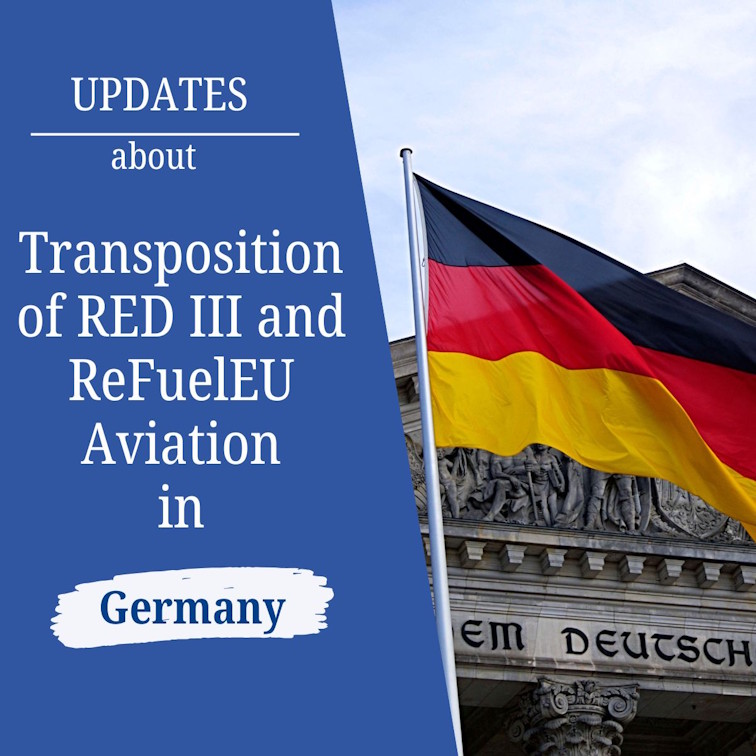
On 10 December, the German Federal Cabinet approved the draft of a Second Law on the Further Development of the Greenhouse Gas Reduction Quota.
This quota, as the central legal instrument for reducing greenhouse gas (GHG) emissions from fuels, shall gradually make refueling more climate-friendly. It specifies the extent to which fuel suppliers must reduce CO2 emissions by using sustainable biofuels, renewable hydrogen-based fuels, or electricity for electric vehicles.
➡️ The Draft of Law is available via this link: Entwurf eines Zweiten Gesetzes zur Weiterentwicklung der Treibhausgasminderungs-Quote
✅ Key Points of the Draft Law:
📌 The draft law implements the amendments to the Renewable Energy Directive (RED III), whose targets must be achieved by 2030. To provide greater investment security, the German government extends the timeline to 2040, going beyond the RED III, to support long-term corporate investment planning.
📌 The law serves to implement the ReFuelEU Aviation Regulation at the national level with regard to fuels.
📌 The draft law includes amendments to the Federal Immission Control Act (BImSchG) and the Regulation on the crediting of electricity-based fuels and co-processed biogenic oils towards the greenhouse gas quota (37th BImSchV).
📌 It introduces definitions of aviation fuel suppliers and distributors, as well as penalties for aviation fuel suppliers that fail to comply with their obligations under the ReFuelEU Aviation Regulation with regard to the share of sustainable aviation fuel (SAF):
- EUR 4,700 per tonne for SAF
- EUR 17,000 per tonne for synthetic aviation fuels or e-SAF.
📌 It defines the eligibility criteria for e-SAF and renewable hydrogen for aviation.
📌 It establishes minimum shares of RFNBOs for fuel suppliers (excluding aviation fuel suppliers):
- 0.1% from 2026
- 0.5% from 2028
- 1.2% from 2030
- 1.5% from 2032
- 2.5% from 2034
- 4.0% from 2036
- 5.0% from 2037
- 6.0% from 2038
- 7.0% from 2039
- 8.0% from 2040
☑️ Next Steps:
- The law will enter into force on the second day after its publication in the Federal Law Gazette.
- The Draft Law must now be submitted to the Federal Council (Bundesrat) and the German Bundestag for debate. Approval by the Federal Council is not required. However, the Bundestag may still introduce amendments.
- After adoption by the Bundestag, the law can be submitted to the Federal President for signature and then published.
- The legislative process is expected to be completed in the first quarter of 2026.